Quanzhou
Qingjing Mosque
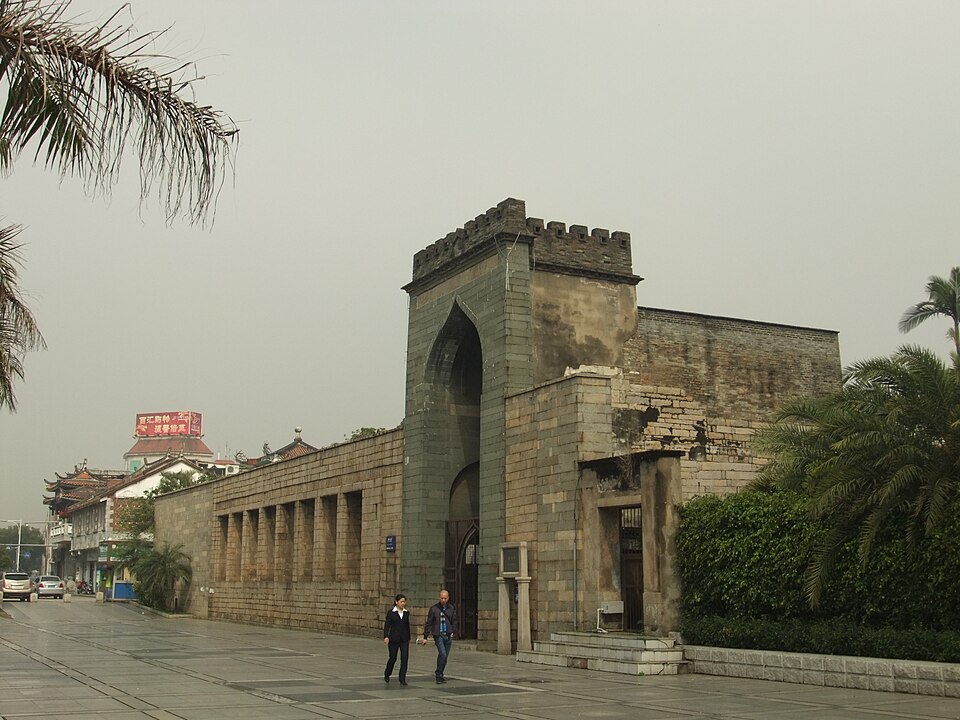
Qingjing Mosque is on the middle section of Tumen Street in Licheng District, Quanzhou. It is an Islamic mosque, not a Buddhist temple, so searches for “Qingjing Ancient Temple” or “Qingjing Temple” can give visitors the wrong expectation. Use Qingjing Mosque or Qingjing Mosque when checking maps and local information.
The site is a National Key Cultural Relics Protection Unit associated with the Northern Song period. It is also one of the component sites of UNESCO’s Quanzhou: Emporium of the World in Song-Yuan China World Heritage property. UNESCO describes it as an 11th-century mosque and one of China’s earlier Islamic buildings. Those designations make it more than a brief stop on a central-city walk: they give the building a defined place in Quanzhou’s documented heritage.
Start with the gateway
The clearest source-backed detail to look for is the gateway. Quanzhou’s official visitor description identifies a West Asian mosque style in its pointed arches. The arches recede in successive layers, creating depth rather than a flat entrance face.
The first two entrance passages also have pointed-arch exteriors and half-domes. Taken together, these elements give the approach a different architectural language from the religious buildings many visitors may expect to see on a Chinese urban street. Spend a moment viewing the full composition before concentrating on one arch or doorway.
The official description also notes a combination of Islamic dome forms and traditional Chinese zaojing decorative treatment. This is a useful detail because it directs attention to how several design traditions appear in the same gateway. You do not need to identify every element to appreciate the contrast: look at the pointed openings, the recessed layers, the domed treatment, and the decorative ceiling forms as parts of one composition.
Why the name matters
The Chinese name Qingjing Mosque is sometimes translated with the word “temple.” That translation can be misleading for trip planning because Qingjing Mosque is an Islamic religious building. It is better to treat the English word “mosque” as the practical identifier when searching, while keeping Qingjing Mosque as the Chinese name that may appear in local listings.
This distinction also helps set an appropriate tone for a visit. The site should not be approached as a generic photo backdrop or confused with a Buddhist temple. Its religious identity and its protected heritage status are both central to what the place is.
Put it into a Tumen Street walk
Its location on the middle section of Tumen Street is the most reliable logistical fact supplied for visitors. Plan it as one stop within a walking block in central Quanzhou, rather than constructing a tightly timed route around details that have not been verified.
The supplied evidence does not confirm current opening hours, admission arrangements, entrance procedures, transport exits, photography rules, or facilities. Check a current official notice or local listing on the day if any of those details affect your plan. If you cannot confirm them, leave room to adjust: reach Tumen Street, find the mosque using its Chinese or English name, and continue your walk according to the conditions you encounter.
That flexible approach is especially sensible for a heritage and religious site. The architectural value is visible in the gateway’s forms and details, while access to particular areas may be governed by current on-site arrangements that can change.
A focused way to look around
A short visit can still be rewarding if you give it a simple structure. First, orient yourself to the street-facing gateway. Next, notice the repeated pointed arches and how they step inward. Then look for the relationship between the half-domes and the Chinese zaojing decoration described by the official source.
This sequence keeps attention on features supported by the available evidence instead of filling the visit with assumptions. It also gives the stop a purpose even when you have limited time: you are looking at a documented combination of West Asian mosque style, Islamic dome forms, and Chinese decorative treatment in a mosque that UNESCO places in the 11th century.
Visit respectfully
Qingjing Mosque is an Islamic religious site. Keep your voice low, follow posted notices and staff directions, and do not assume that every area is open to visitors or photography. If a sign is unclear or an area is unavailable, choose the respectful option and continue with your walk.
Wear clothing suitable for both walking and a religious setting. Bring water in warm weather, but do not assume that food, drink, restrooms, lockers, or other visitor facilities are available on site. These are practical precautions, not confirmed services.
Before you go
For factual orientation, rely on the mosque’s confirmed location, identity, protected status, architectural description, and UNESCO connection. For day-of-visit details, verify them separately through a current official channel. Do not let an unconfirmed opening hour or ticket rule become the weak point in your schedule.
Qingjing Mosque is best for travelers who want a precise architectural and heritage stop in central Quanzhou. Its value lies in what can be documented: an Islamic mosque on Tumen Street, an 11th-century UNESCO component site, and a gateway where pointed arches, half-domes, Islamic dome forms, and Chinese zaojing decoration meet.
Highlights
- Located on the middle section of Tumen Street in Licheng District, Quanzhou.
- An Islamic mosque, not a Buddhist temple.
- A National Key Cultural Relics Protection Unit associated with the Northern Song period.
- A component site of UNESCO’s Quanzhou World Heritage property.
- Its gateway has layered pointed arches, half-domes, Islamic dome forms, and Chinese zaojing decoration.
- Search with Qingjing Mosque or Qingjing Mosque for clearer local results.
Travel Tips
Search with the mosque name
Use Qingjing Mosque or Qingjing Mosque when checking maps and local information. “Qingjing Temple” can obscure that this is an Islamic mosque.
Look at the gateway as a whole
Start with the layered pointed arches, then notice the half-domes and the combination of Islamic dome forms with Chinese zaojing decoration.
Verify day-of-visit details
The supplied evidence does not confirm current hours, entry rules, fees, photography policies, or facilities. Check a current official notice if these details matter to your plan.
Respect the religious setting
Keep your voice low, follow posted notices and staff directions, and do not assume every area or photograph is open to visitors.
More to see in Quanzhou
Tianjin Tianhou Palace: Hours and Address
Quanzhou Tianhou Temple: World Heritage Visit Guide (2026)
Quanzhou Maritime Museum: Hours, Galleries & Visit Guide (2026)
Quanzhou Kaiyuan Temple: Free Entry, Twin Pagodas & Visit Guide (2026)
Quanzhou Kaiyuan Temple 2026: Free Entry, Hours and Visit Tips