Hanzhong
Wuhou Temple, Mian County, Hanzhong: Practical Guide (2026)
Wuhou Temple in Mian County is the Hanzhong-area shrine dedicated to Zhuge Liang, not the better-known site of the same name in Chengdu. Its importance comes from a documented order issued in 263 by the Shu Han ruler Liu Shan. Local historical authorities describe it as the earliest Wuhou temple and the only one founded by imperial decree.
This is also a separate place from Wuhou Tomb. The temple commemorates Zhuge Liang; his burial site stands near Dingjun Mountain elsewhere in Mian County. Keeping those names separate will prevent map and booking errors.
Why is Mian County Wuhou Temple historically important?
Zhuge Liang used the Mian County area as a military base during campaigns between 227 and 234. After his death, officials Xi Long and Xiang Chong petitioned for a formal place where people could honor him. Liu Shan approved a temple at Mianyang, the historical name associated with this area, in 263.
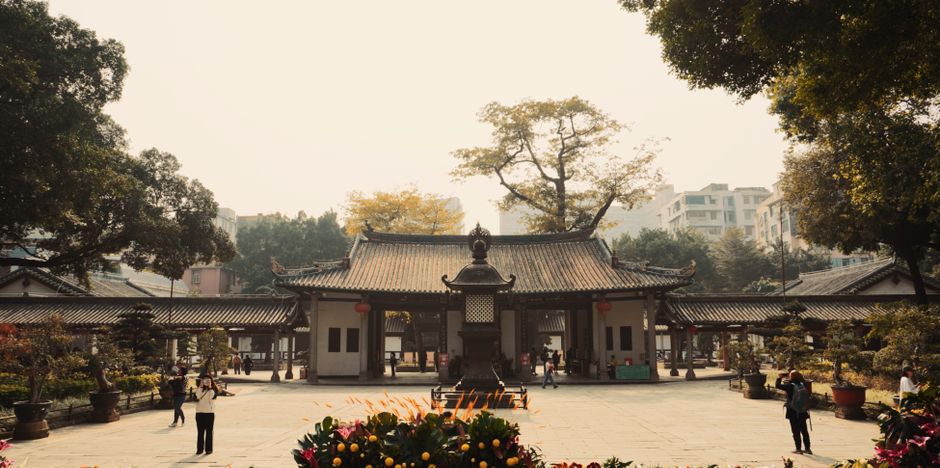
The surviving compound reflects later rebuilding rather than an untouched third-century structure. An item-specific account published by the Hanzhong Municipal Government says a major restoration took place in 1801 and that the buildings seen today mainly display Qing architectural features. Read the site as a long record of commemoration, repair and reinterpretation, not as a frozen Three Kingdoms ruin.

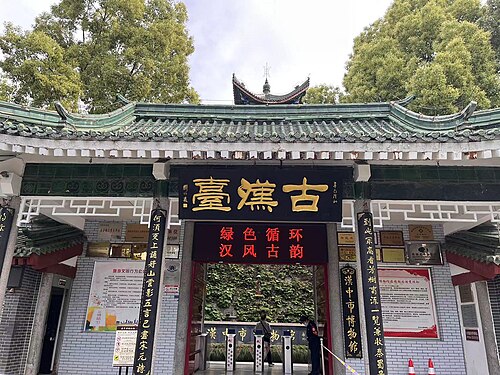
Main hall of Wuhou Temple in Mian County
The main hall in Mian County. Photo by N509FZ, licensed CC BY-SA 4.0 via Wikimedia Commons.
What should you look for inside?
Do not rush directly through the central buildings. Much of the experience lies in the relationship between halls, courtyards, old trees, calligraphy and carved stone.
The most significant documented object is a Tang-period stele erected in 795. Its text was composed by Shen Jiong and written by Yuan Xi. The Hanzhong government account identifies it as the Stele and Preface for the New Temple of Zhuge, the Loyal and Martial Marquis. It joined China’s first national list of ancient celebrated steles and inscriptions in 2023.
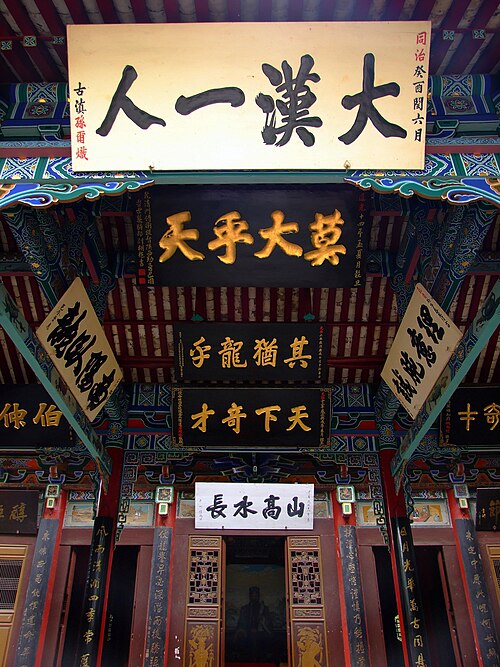
The same account records 63 historical steles and 33 plaques or inscribed couplets at the temple. One prominent plaque in the main hall bears the words Zhong Guan Yun Xiao, an expression praising loyalty reaching into the clouds, and is linked to the 1801 restoration under the Jiaqing emperor.
The grounds also contain protected old trees. A distinctive dry lotus tree is reported to be about 400 years old and normally flowers in March. Treat the month as a seasonal guide, not a guaranteed bloom date, since weather can shift the flowering period.

Inscribed plaque inside Hanzhong Wuhou Temple
An inscribed plaque inside the complex. Photo by Charlie fong, released into the public domain and also available under the licenses listed by Wikimedia Commons.
What are the 2026 opening hours and ticket price?
The official item-specific pages available for this guide do not provide a current, dated 2026 admission notice or daily opening schedule. Prices and hours shown by booking platforms may be copied from older seasons, so they are not reproduced here as confirmed visitor information.
| Planning question | What is verified | Safest action |
|---|---|---|
| Admission price | No current official tariff was found in the cited government pages | Confirm the price directly shortly before visiting |
| Opening hours | No current dated schedule was found in the cited official pages | Check on the day before making a long transfer |
| Advance booking | No current official reservation rule was confirmed | Ask whether foreign passports can be used at the ticket window or booking channel |
| Temporary closures | Heritage maintenance can affect access, but no current closure is asserted here | Recheck after severe weather and around public holidays |
Save both names, Mianxian Wuhou Temple and Mianxian Wuhou Temple Museum, on your phone. They make it easier for accommodation staff or a driver to verify the correct attraction without confusing it with Chengdu’s Wuhou Shrine.
How do you get there from Hanzhong?
The temple is in Wuhou Town, west of Mian County’s urban center. Two official Hanzhong descriptions place it roughly three to four kilometers west of the county seat, reflecting normal rounding rather than different sites.
For navigation, search the full Chinese name instead of typing only “Wuhou Temple.” If you are staying in central Hanzhong, plan the temple as an excursion into Mian County. A direct road transfer is simpler, while travelers already in Mian County can arrange a local taxi or ride-hailing car. Because the official pages cited here do not publish a current bus route or stop timetable, confirm any public-transport connection locally instead of relying on an old route number.
Before entering, settle how you will return, especially if your driver will not wait. Show the Chinese destination name and confirm that the driver means the temple, not Wuhou Tomb.
When is the best time to visit?
March is the most distinctive documented season because of the old dry lotus tree’s flowering period. If that is your main reason for visiting, ask locally whether it has begun to bloom before making a special journey.
At other times, prioritize a dry day. Exterior details, rooflines and stone inscriptions are easier to examine without heavy rain. The site rewards slow reading, so visitors interested in calligraphy or Three Kingdoms history should leave more time than someone making a quick photographic stop.
Can you combine it with other Three Kingdoms sites?
Yes. Official local coverage identifies Wuhou Tomb and Ma Chao Tomb as other important sites in Mian County. Wuhou Tomb is the burial place connected with Zhuge Liang, while Wuhou Temple is the commemorative shrine described here. They should be treated as separate attractions with independently checked admission arrangements and visiting times.
A sensible themed outing starts with the temple’s political and commemorative story, then continues to the tomb landscape. Add further sites only after checking travel time and same-day access. This approach leaves room to read the inscriptions instead of turning the visit into a sequence of entrance photographs.
Visitor etiquette and accessibility
This is both a visitor attraction and a protected historical environment. Keep food away from halls and inscriptions, do not touch carved stone or old trees, and avoid blocking worship or commemorative activity. Use subdued voices inside enclosed halls.
The reviewed official pages do not provide a current accessibility statement covering step-free routes, wheelchairs or accessible toilets. Travelers who need these facilities should obtain direct confirmation before departure. Traditional thresholds, stone paving and courtyard level changes may require additional assistance, but conditions should be checked with the site rather than assumed.
Frequently asked questions
Is this the Wuhou Shrine in Chengdu?
No. This temple is in Mian County under Hanzhong, Shaanxi. Chengdu’s Wuhou Shrine is a different attraction in Sichuan. Include “Mianxian” in every map search.
Is Zhuge Liang buried inside the temple?
No. The temple commemorates him. Wuhou Tomb, associated with his burial near Dingjun Mountain, is a separate attraction in Mian County.
Why is the year 263 important?
It is the year in which Liu Shan ordered the establishment of a temple for Zhuge Liang at Mianyang. That imperial origin is central to the site’s identity.
What is the most important inscription?
The best-documented highlight is the Tang stele erected in 795. Look for it slowly and use a translation or guide if the historical Chinese text is difficult to follow.
Should I trust ticket prices shown on travel apps?
Treat them as provisional unless the attraction confirms them. No current dated official tariff was available in the item-specific government sources reviewed for this 2026 guide.
Before you leave Hanzhong
- Save the exact Chinese attraction name and distinguish it from Wuhou Tomb.
- Reconfirm the opening schedule, admission price and passport ticketing procedure.
- Arrange the return journey before entering if you are using a private transfer.
- Bring a translation app for plaques and historical explanations.
- Focus on the Tang stele, Qing-period architecture, inscribed plaques and old trees rather than trying to photograph every courtyard.
Highlights
- The earliest Wuhou temple according to local historical authorities, founded by imperial order in 263
- A surviving complex whose visible architecture mainly reflects Qing-period rebuilding
- A nationally recognized Tang stele erected in 795
- Courtyards combining historical buildings, inscribed stone, calligraphy and old trees
- A centuries-old dry lotus tree associated with a March flowering period
- A useful starting point for understanding Mian County’s Zhuge Liang heritage
Travel Tips
Use the full Chinese name
Search for Mianxian Wuhou Temple Museum and include Mianxian in messages to drivers. “Wuhou Temple” alone can produce results for Chengdu or other cities.
Verify 2026 visitor details
The cited official pages do not supply a current dated ticket tariff or daily schedule. Confirm admission, opening time and passport ticketing shortly before departure.
Do not confuse the temple and tomb
Wuhou Temple is the commemorative shrine; Wuhou Tomb is a separate site. Confirm which one a driver, map result or tour listing means.
Check the bloom before a March trip
March is associated with the old dry lotus tree’s flowers, but the exact bloom depends on conditions. Ask locally before traveling solely for it.