Luoyang
White Horse Temple, Luoyang
White Horse Temple, Luoyang: Tickets, Hours and How to Visit in 2026
White Horse Temple is about 12 kilometers east of central Luoyang and rewards a slower visit than its compact central courtyards first suggest. Come for the place traditionally identified as China’s first government-built Buddhist temple, then stay for the historic halls, Yuan-dynasty sculptures, Qingliang Terrace and Qiyun Pagoda.
The temple remains a religious site as well as a protected attraction. Plan around the reservation requirement, walk through the Chinese temple compound in order and leave enough time for the pagoda area. Two to three hours works for most first visits, while architecture or Buddhist-history enthusiasts may want longer.
Why is White Horse Temple important?
Official accounts date the foundation to AD 68, during the Eastern Han dynasty. According to the traditional narrative, Emperor Ming sent envoys west in search of Buddhist teachings. They returned to Luoyang with the Indian monks Kāśyapamātaṅga and Dharmaratna, scriptures and a Buddhist image carried by a white horse. The new monastery was consequently named White Horse Temple.
Its importance is more specific than the loose claim that it was simply China’s first Buddhist place. Government and cultural authorities describe it as the first temple constructed by the state after Buddhism reached China. It became associated with early translation work and earned the honorific titles “ancestral temple” and “source of Buddhism” within Chinese Buddhist history.
Qingliang Terrace is tied to the temple’s early translation tradition. The Academy of Contemporary China and World Studies identifies it as an early scripture-translation workshop and associates the temple with the Chinese translation of the Sutra of Forty-Two Chapters. The buildings visitors see now come from many later periods because the complex was repeatedly damaged, rebuilt and expanded.
What should you see inside White Horse Temple?
Follow the south-to-north axis rather than moving randomly between courtyards. This preserves the hierarchy of the traditional layout and makes the changing images inside the halls easier to understand.
- Main gate and stone horses: A pair of stone horses stands outside the gate. The district government identifies them as Song-dynasty sculptures, linking the entrance directly to the story behind the temple’s name.
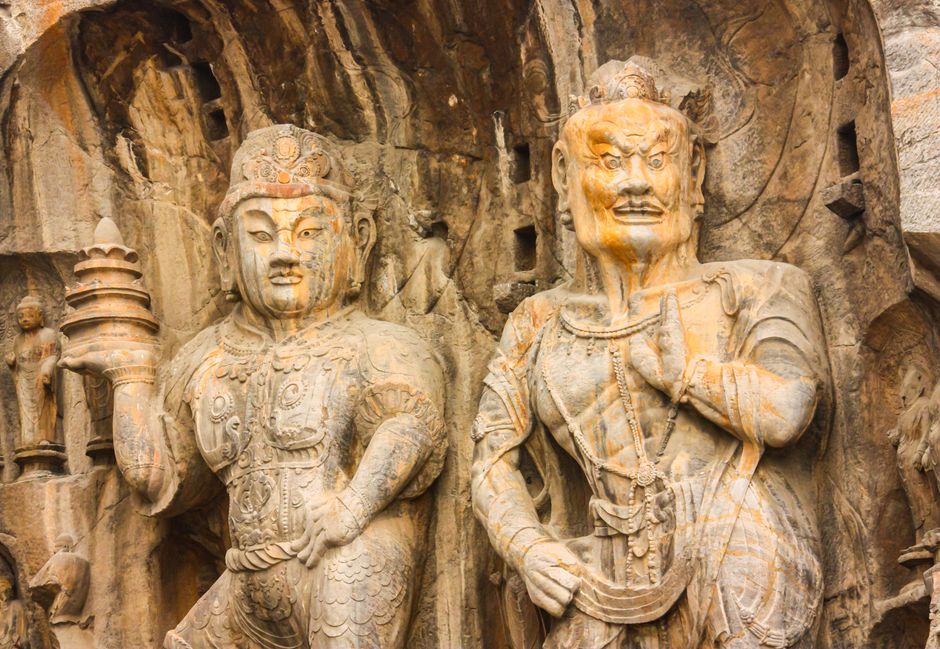
- Hall of Heavenly Kings: This is the first of five principal buildings on the central axis. It introduces the protective figures traditionally placed near the entrance of a Chinese Buddhist monastery.
- Great Buddha Hall: The district’s scenic-area guide describes this as the main ritual hall and dates its reconstruction to the Ming dynasty. Its central image of Śākyamuni is accompanied by Mañjuśrī, Samantabhadra, Kāśyapa and Ānanda.
- Mahavira Hall: Look closely at the group of eighteen arhats. The official attraction overview identifies these figures as Yuan-dynasty works. The same hall contains carved niches holding thousands of smaller Buddha images.
- Reception Hall and Qingliang Terrace: Continue through the smaller Reception Hall before climbing toward the terrace and Vairocana Pavilion. Side halls commemorate the two Indian monks connected with the temple’s founding narrative.
- Qiyun Pagoda: Do not finish at the last central hall. Walk to the pagoda southeast of the main compound. The present square brick structure has 13 levels and was rebuilt in 1175 during the Jin dynasty. The district overview gives its height as about 25 meters.
Keep the route flexible if a hall is being used for worship or temporarily closed. Read posted restrictions before photographing interiors, and give worshippers space in front of altars.
How much are tickets and what are the opening hours?
The ticket and schedule information below was checked against the currently published district-government visitor policy in July 2026. Temporary closures, severe weather and major religious dates can still change access.
| Visitor information | Published policy |
|---|---|
| Standard admission | ¥35 per person |
| Summer opening hours | 07:40–18:30 |
| Winter opening hours | 08:00–17:30 |
| Visitors aged 60 or above | Free with qualifying identification |
| Children aged 12 or below, or no taller than 1.4 meters | Free with qualifying identification |
| Visitors aged over 12 through 18 and eligible full-time students | Half price with the required documents |
The government page labels the schedules only as summer and winter without defining the changeover dates. Check the official account shortly before visiting instead of assuming a calendar cutoff. Last admission may also be earlier than closing time.
Do you need to reserve White Horse Temple tickets?
Yes. Since September 11, 2025, White Horse Temple has required online, timed and real-name reservations through the official WeChat account “Luoyang Baima Temple.” The notice applies to full-price and discounted tickets, organized groups, tourism-pass users and visitors entitled to free admission.
Reserve before traveling to the eastern edge of the city. Bring the identification used for the reservation and any original document needed for a concession. At entry, follow the instructions attached to your booked period and present the accepted identification or official booking code. The reservation notice tells people without a booking not to travel to the attraction. For booking assistance, it publishes the telephone number 0379-63789090.
Avoid unofficial sellers. A separate temple notice states that White Horse Temple has not authorized third-party platforms to sell its tickets. Use the official account and confirm that the publisher is Luoyang Baima Temple before paying.
How do you get to White Horse Temple from Luoyang?
A practical public-transport route is Metro Line 1 to Yangwan Station, followed by the dedicated connection toward White Horse Temple. A Luoyang municipal transport presentation describes the Yangwan-to-temple shuttle as approximately 6 kilometers and 15 minutes, with boarding points near the north side of Yangwan Station and Shiyuan Square.
The same city document lists Shenduyou tourist line 5 between Yangwan Metro Station and White Horse Temple’s Shiyuan Square, with a published service window of 09:00–17:00. It also lists tourist connections from Longmen Grottoes and Luoyi Ancient City. These services can be adjusted for weather, demand or holidays, so check a live map or local transport notice on the day.
A taxi or app-based car is simpler if you are carrying luggage or arriving outside shuttle hours. Enter the Chinese name Baima Temple and confirm that the destination is the Luoyang temple, not another place with a similar name.
When is the best time to visit?
China Weather’s Luoyang climate guide recommends autumn. It describes spring as dry and windy, summer as hot and rainy, autumn as mild, and winter as cold with limited rain or snow. For a quieter experience in any season, reserve an early period and enter near the beginning of it.
April brings additional travelers to Luoyang for the city’s peony season. If your dates overlap a major holiday or city festival, make the temple reservation before fixing the rest of that day’s route.
How should visitors behave at the temple?
Wear clothing suitable for an active place of worship, speak quietly around halls and do not block people praying or making offerings. Never touch statues, painted surfaces, carved niches or the stone horses. Follow local signs concerning photography because access can differ between buildings.
Incense is not required for a meaningful visit. The district’s public-facilities listing notes a free incense-distribution point, along with a visitor center, resting areas and drinking-water containers. If you participate, follow staff directions and use only the designated burners.
Frequently asked questions
How long should I allow for White Horse Temple?
Allow two to three hours for the main axis, Qingliang Terrace and Qiyun Pagoda. Add time if you plan to read the interpretation panels or observe architectural details.
Can I enter without a reservation if admission is free for me?
No. The timed-reservation notice explicitly includes visitors eligible for free admission. Book through the official WeChat account and bring the supporting identification.
Is White Horse Temple the oldest surviving temple building in China?
That is not the most accurate description. The institution traces its foundation to AD 68, but the visible complex was rebuilt across later dynasties. Its central importance is its status as the first state-founded Buddhist temple after Buddhism entered China.
Is Qiyun Pagoda part of the visit?
Yes, it is one of the attraction’s defining historic structures. It stands southeast of the central compound, so include it deliberately rather than turning back after the final hall.
What should I do if the official booking system is unclear?
Use the consultation number published in the reservation notice, 0379-63789090. Confirm availability before making the cross-city journey.
Highlights
- Founded in AD 68 and identified by cultural authorities as China’s first government-built Buddhist temple after Buddhism arrived
- Five principal halls arranged along a clear south-to-north axis
- Song-dynasty stone horses beside the entrance recall the temple’s founding narrative
- Yuan-dynasty eighteen-arhat sculptures preserved inside the Mahavira Hall
- Qingliang Terrace, associated with early Buddhist scripture translation in China
- The 13-level Qiyun Pagoda, rebuilt in 1175 during the Jin dynasty
Travel Tips
Reserve through the official account
Every visitor, including children, concession holders and people entitled to free entry, needs a timed real-name reservation through the official Luoyang Baima Temple WeChat account.
Bring matching identification
Carry the identification used for booking and the original documents required for any free or half-price ticket.
Continue to Qiyun Pagoda
Do not turn back after the final central hall. The historic pagoda stands southeast of the main compound and deserves a separate stop.
Check same-day transport
Tourist buses and the Yangwan connection may change during holidays or bad weather. Verify the live route before leaving central Luoyang.