Datong
Hanging Temple
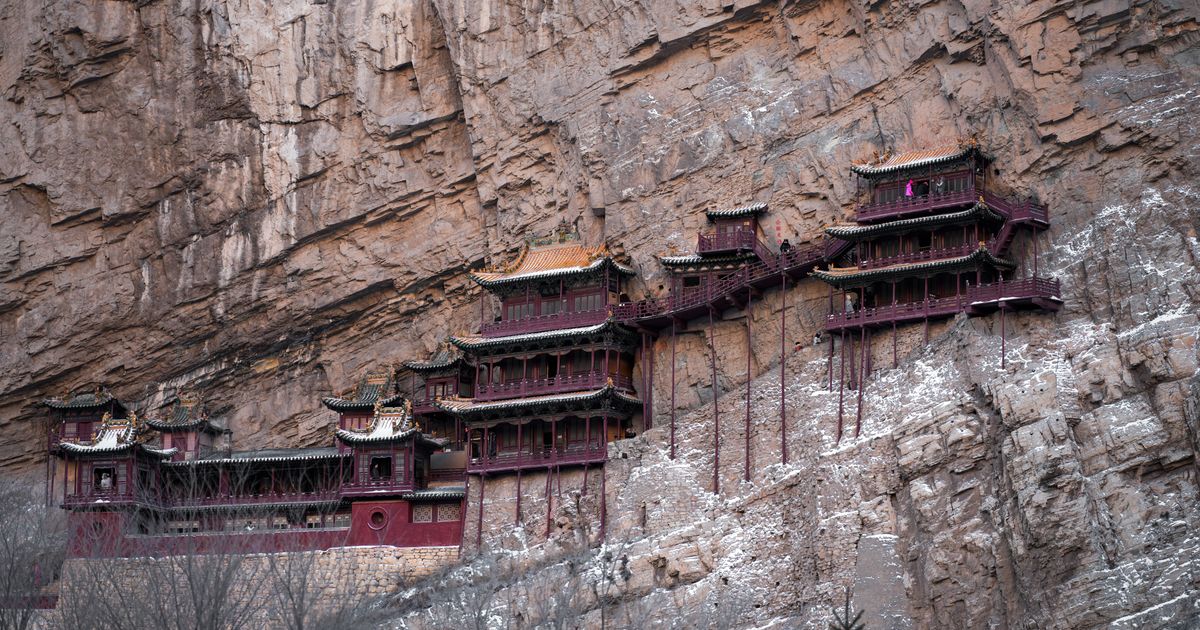
The row of thin wooden poles under the Hanging Temple looks like the only thing keeping it from sliding off the cliff. It isn't. Pinned to a sheer rock face in the gorge below Mount Heng, about 65 km southeast of Datong near Hunyuan, the monastery actually hangs from oak crossbeams driven deep into holes chiselled in the cliff. The slender poles beneath the galleries were added later and mostly steady the floors: take them away and the temple would still hold. It was founded late in the Northern Wei period, traditionally credited to a monk named Liaoran around 491 AD, and rebuilt many times since, surviving centuries of weather and the occasional earthquake.
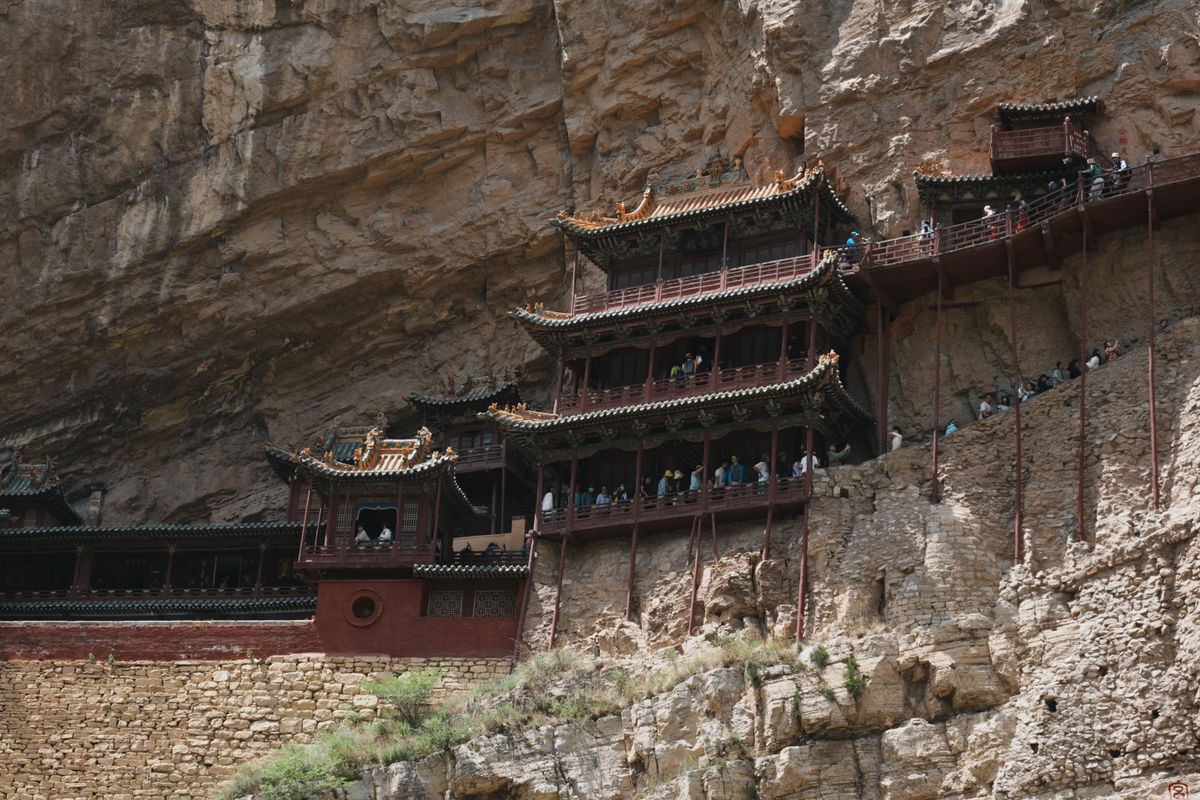
The Hanging Temple suspended on a cliff near Datong
What sets the temple apart, beyond its perch, is what it honours. About forty small halls and walkways hold statues of the Buddha, Laozi and Confucius side by side, with Shakyamuni in the centre, Laozi to one side and Confucius to the other. That makes it one of the few places in China dedicated to all three of the country's great teaching traditions at once. The interiors are tight, the staircases steep, and the wooden galleries narrow enough that crowds shuffle rather than stride, so the climb itself is part of the visit.
Tickets, the shuttle and getting up on the structure
The site reopened on 1 May 2026 after maintenance and rockfall safety work. Access has tightened since: all visitors now park at the Hengshan Tourist Center and ride the official scenic shuttle to the foot of the cliff, so there is no driving straight to the gate. Tickets come in two parts, a scenic-area ticket to see the temple from below and a separate, capped "boarding" ticket to actually walk the structure. The boarding ticket is limited to a set number of people a day and is not guaranteed even if you book ahead; if it sells out, you can still view the temple from the gorge floor. Reserve it early, wear shoes with grip, and be honest with yourself about heights, because the galleries hang directly over the drop.
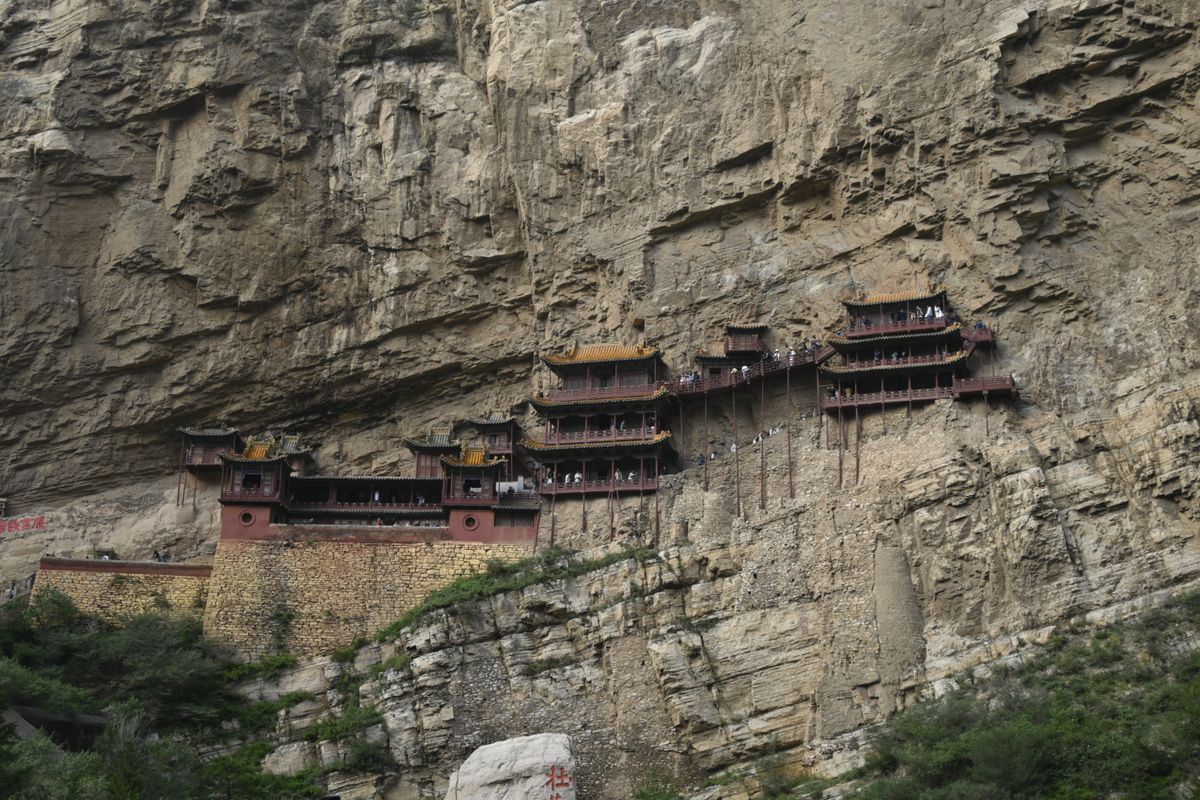
Wooden galleries of the Hanging Temple
Why it has lasted 1,500 years
The temple climbs the cliff in three tiers linked by plank walkways and narrow internal stairs. Its survival owes as much to the site as to the carpentry: a slight overhang in the rock shelters the timber from rain and most direct sun, while the gorge funnels floodwater below the structure rather than against it. The building was repaired repeatedly under the Ming and Qing, but the load-bearing idea has not changed, the beams in the rock carry the weight and the visible poles only help.
When to go
Late spring and early autumn are the most comfortable months, both for the exposed walkways and for clearer skies over the gorge. Summer brings the biggest crowds and the slowest queues to climb, so if you want the boarding ticket, aim for an early or late slot rather than midday. Allow two to three hours including the shuttle transfer, and pack water and a layer, since the cliff stays breezy even on warm days.
Around Hunyuan and Mount Heng
The temple sits at the foot of Mount Heng, the northern peak of China's five sacred Taoist mountains, so the wider area rewards a longer look. Trails above the monastery climb to Taoist shrines on the upper slopes, and the small town of Hunyuan is known for its liang fen, a chilled starch jelly served with chilli and vinegar. The most efficient plan is to pair the Hanging Temple with the Yingxian Wooden Pagoda, about an hour west, or with the Yungang Grottoes back toward Datong, and many local day tours sell exactly that loop.
Highlights
- A 1,500-year-old monastery pinned to a sheer cliff in the Mount Heng gorge
- Oak crossbeams set into the rock that carry the real load behind the slender visible poles
- About forty halls honouring the Buddha, Laozi and Confucius together
- Reopened on 1 May 2026 after maintenance, with a capped daily boarding ticket
- Reached via a park-and-ride shuttle from the Hengshan Tourist Center
Travel Tips
Book the boarding ticket, but have a plan B
You need a scenic-area ticket to view the temple plus a separate, capped boarding ticket to walk it. The boarding ticket sells out and is not guaranteed even if you reserve, so if it's gone you can still view the temple from below.
Park at the tourist center and ride the shuttle
All visitors now park at the Hengshan Tourist Center and take the official shuttle to the cliff, so build in extra time for the transfer. The temple is about 65 km southeast of Datong near Hunyuan.
Mind the heights and the timing
Galleries are narrow and hang over the gorge, so it gets slow and busy by midday. Visiting hours run roughly 08:00 to 18:00 in summer and close earlier in winter, and daytrippers often add Yungang or the Yingxian Wooden Pagoda nearby.