144-Hour Transit Guangzhou: Baiyun Airport's 2026 Rule Is Now 240 Hours
Quick answer: If you searched "144 hour transit Guangzhou," the number is outdated. Since December 17, 2024, Guangzhou Baiyun International Airport (CAN) runs on China's 240-hour (10-day) visa-free transit rule, not 144 hours. Citizens of 55 eligible countries with a confirmed onward ticket to a different country or region can skip a visa entirely, including Canton Fair buyers, as long as the trip is a genuine transit and not a round trip home.
Baiyun is one of the busiest transit hubs in southern China, and it happens to sit a short ride from the Canton Fair Complex in Pazhou, so a lot of the traffic asking about "144-hour Guangzhou" turns out to be business travelers trying to figure out if a fair visit qualifies. It usually does, with one catch that trips people up more than any visa form. We cover the full national picture, including how the old 144-hour rule became 240 hours, in our 144-hour visa-free transit guide; this piece narrows in on what's specific to Baiyun and the Canton Fair.
What Guangzhou's transit rule allows in 2026
Baiyun Airport has offered some form of short-stay visa-free transit since before the current rule existed. What changed is the ceiling: the old 72/144-hour windows were folded into one 240-hour allowance nationwide, and Guangdong's ports (Baiyun included) were confirmed under that expanded scheme, with a further round of Guangdong port additions taking effect in November 2025.
Three things determine whether you qualify:
- Your passport is one of the roughly 55 eligible nationalities (most of the EU, the UK, the US, Canada, Australia, Japan, South Korea, Singapore, and others; Indonesia was added in mid-2025).
- You hold a confirmed onward ticket, with a specific date and seat, to a country or region different from the one you flew in from. Departure has to happen within 240 hours of arrival.
- You enter and exit through one of the approved ports.
Unlike the pre-2024 rules, the region lock is gone. Landing at Baiyun doesn't confine you to Guangdong; you can move across any of the 24 provinces and municipalities on the national list. In practice, most Canton Fair visitors stay inside Guangdong anyway because ten days isn't much time once you factor in the fair itself, but it's worth knowing you're not boxed in the way earlier travelers were under the old regional clusters.
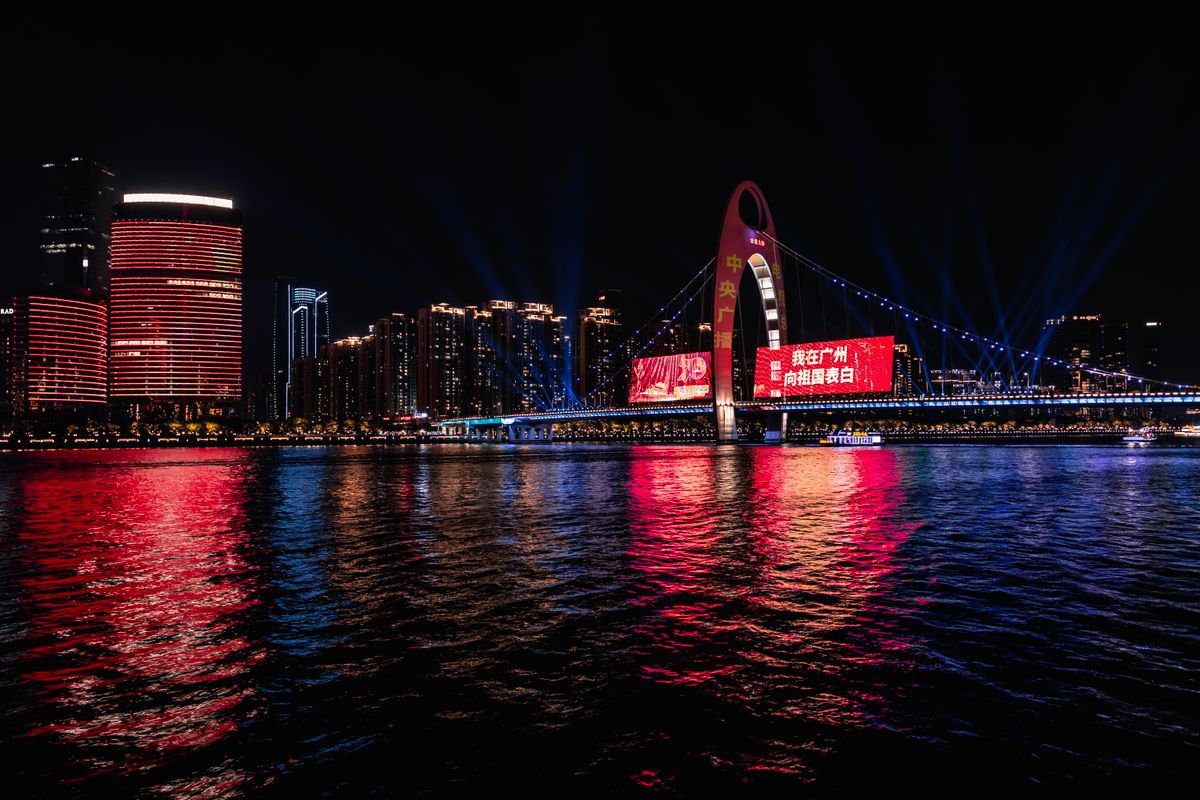
Guangzhou skyline reflected in the Pearl River at night
Ports that count in the Guangzhou area
| Port | Type | Notes |
|---|---|---|
| Guangzhou Baiyun International Airport (CAN) | Air | Main entry/exit for most fair visitors |
| Guangzhou Pazhou Passenger (Ferry) Port | Sea | Added November 2025 |
| Shenzhen Bao'an International Airport | Air | Alternate air gateway, ~2 hours from Pazhou |
| Hong Kong-Zhuhai-Macao Bridge Port | Land | Direct road link from Hong Kong/Macau |
| West Kowloon Station (Guangzhou-Shenzhen-Hong Kong high-speed rail) | Rail | Added November 2025; through-train from Hong Kong |
| Zhuhai Gongbei / Hengqin | Land | Macau border crossings |
| Zhongshan Port | Sea/land | Added November 2025 |
Shenzhen, Beijing, and Shanghai each run under the same national 240-hour framework but have their own port lists and local quirks worth checking separately if your itinerary touches them.
The Canton Fair scenario: does 144-hour transit cover a business trip?
This is the part most guides skip. The 240-hour rule doesn't ask what you're doing in China, so a buyer walking the exhibition floor, collecting samples, or having informal supplier meetings is covered the same as a tourist, no business visa required, as long as the underlying transit condition is met.
That condition is the catch: your entry and exit countries have to differ. A trader flying Seoul to Guangzhou to Ho Chi Minh City, using the Canton Fair days as the layover, qualifies cleanly. Someone flying straight from their home country to Guangzhou and straight back on a round-trip ticket does not, because there's no third country in that itinerary. Immigration officers check the onward ticket at the gate, and entering under the transit facility without genuinely continuing to a different country counts as an improper entry, not a shortcut.
The 139th Canton Fair (spring 2026) already wrapped up by the time you're reading this; the 140th session runs in autumn.
| Canton Fair 2026 (Autumn, 140th session) | Dates | Focus |
|---|---|---|
| Phase 1 | Oct 15-19 | Electronics, machinery, tools |
| Phase 2 | Oct 23-27 | Consumer goods, gifts, home decor |
| Phase 3 | Nov 1-5 | Textiles, apparel, medical & health products |
The fair runs at the China Import and Export Fair Complex in Pazhou, Haizhu District, Guangzhou.
Guangzhou's business district skyline at sunset over the Pearl River
If your trip is genuinely round-trip and you need to sign contracts, exhibit a booth under your own company's name, or attend meetings that require a formal introduction, the transit rule isn't the right tool. That's what the M business visa is for, and the Canton Fair's own Buyer E-Service Tool (BEST) issues a free invitation letter online once you register as a buyer, which most Chinese consulates accept as supporting documentation for the M visa application. Don't confuse "no purpose check" with "no visa ever needed" for that scenario.
Getting from Baiyun into the city and beyond
Metro Line 3 (with a change) or the airport express bus gets you from Baiyun to central Guangzhou in roughly 45 minutes to an hour; to reach Pazhou specifically, most visitors take the metro to Pazhou station on Line 8, about an hour door to door with the transfer. Taxis and ride-hailing apps run the same route in 40-60 minutes depending on traffic.

Some links are affiliate links; we may earn a commission at no extra cost to you.
If your itinerary already has you connecting onward, the two most useful rail links from Guangzhou are the Guangzhou to Shenzhen train, useful if your transit routing continues through Shenzhen Bao'an, and the Guangzhou to Hong Kong train. That second one matters more than it looks: Hong Kong counts as its own separate region for transit purposes, so a confirmed high-speed rail ticket onward to West Kowloon can satisfy the "third country or region" condition on its own, no flight required. For day-to-day payments while you're at the fair, Alipay's official app now supports foreign cards for short-term visitors and is worth setting up before you land.
Common mistakes
- Assuming a round trip to the fair qualifies. Flying home country to Guangzhou to home country is not a transit itinerary under this rule, no matter how short the stay. You need a proper visa (L or M) if that's your actual routing.
- Confusing 144 hours with the current 240-hour rule. The 144-hour figure is what older articles, some airline pages, and even a few consulates' outdated FAQs still quote. It stopped being current in December 2024.
- Treating visa-free transit as a substitute for the M visa when doing real business. No purpose declaration is required for the transit facility, but signing contracts, exhibiting under a company name, or attending invitation-only meetings still calls for the proper visa channel.
- Assuming you're locked to Guangdong. The old regional clusters are gone; the current rule lets you move across 24 provinces, though most Canton Fair trips don't need that range.
- Skipping the confirmed onward ticket. An open-dated or unconfirmed booking gets refused at check-in. Book (and be ready to show) a specific flight or train with a fixed date and seat.
Who this is for
This transit route works well for buyers and sourcing agents already on a multi-leg international itinerary who can route Guangzhou between two different countries, casual Canton Fair visitors walking the floor and meeting suppliers informally, and short layovers built around the fair dates that stay under ten days.
It does not work for anyone on a simple round-trip ticket to their home country, anyone who needs to exhibit, sign, or formally represent a company at the fair (get the M visa instead), travelers from outside the roughly 55 eligible nationalities, or anyone planning to stay past the 240-hour clock. Shenzhen, Beijing, and Shanghai each have separate transit rules under the same national framework if your business travel touches those cities instead.
Before you fly, worth double-checking:
- Your nationality is on the current 55-country list (check with your airline or the consulate, since the list has changed twice since 2024).
- Your onward ticket shows a confirmed date, seat, and a country different from where you departed.
- You're entering and leaving through one of the approved Guangdong ports.
- You have accommodation and an itinerary that fits inside the 240-hour window, counted from midnight the day after you land.
FAQ
Is the 144-hour transit rule still active in Guangzhou in 2026? No. It was replaced nationwide by the 240-hour (10-day) rule on December 17, 2024, and Baiyun Airport operates under that current version.
Can I attend the Canton Fair on 240-hour visa-free transit if I'm flying straight home afterward? No. A round trip to and from your home country isn't a transit itinerary. You'd need an L (tourist) or M (business) visa instead.
Do I need a business visa just to walk the Canton Fair as a buyer? Not if your entry otherwise qualifies as genuine transit or you're on a standard tourist visa. You only need the M visa for formal business activity like exhibiting or contract signing.
What ports besides Baiyun Airport count for Guangzhou's visa-free transit? Shenzhen Bao'an Airport, the Guangzhou Pazhou passenger port, the Hong Kong-Zhuhai-Macao Bridge, West Kowloon Station, and the Zhuhai and Zhongshan crossings all count under the same Guangdong network.
How long is the layover from Baiyun to the Canton Fair complex? Budget about an hour door to door via the metro (Line 3 with a transfer to Line 8), or 40-60 minutes by taxi depending on traffic.
Sources
Not sure if you even need a visa?
Check your China visa-free eligibility →
Sources
- Visa-Free Transit Policies · National Immigration Administration of China
- China widens visa-free access in latest opening-up move · The State Council of the People's Republic of China
- Applying for Invitation (For China Visa Application) · China Import and Export Fair (Canton Fair)