Shanghai to Wuxi Train: Duration, Price & the Lingshan Buddha Day Trip (2026)
Quick answer: The fastest Shanghai to Wuxi train takes 25 to 30 minutes from Shanghai Hongqiao station, with most departures landing in the 40 to 55 minute range. Second-class tickets run about CNY 27 to 54 depending on train type and how far ahead you book. From Wuxi Railway Station, it's another 35 to 45 minutes by taxi or direct bus to the Lingshan Grand Buddha, which makes the whole loop an easy one-day trip from Shanghai.
Wuxi sits on the Beijing-Shanghai and Shanghai-Nanjing high-speed corridors, so it gets some of the densest bullet train service of any city near Shanghai. That density is exactly why this route confuses first-time visitors: there are two train types, two Shanghai stations worth knowing about, and an 88-meter bronze Buddha statue that most guidebooks barely mention.
High-speed train crossing an elevated bridge near Shanghai
For step-by-step guidance on registering, choosing between 12306 and Trip.com, and boarding with only your passport, see our complete guide to booking China's high-speed trains.
How long does the Shanghai to Wuxi train take?
The nonstop G-series trains cover the roughly 128 km between Shanghai Hongqiao and Wuxi in 25 to 30 minutes at speeds up to 350 km/h. That's the number most search results lead with, and it's accurate for the fastest handful of daily departures.
In practice, most of the 250-plus daily trains on this route make one or two intermediate stops (usually Suzhou or Suzhou North), which stretches the ride to 40 to 55 minutes. D-series trains, which top out around 200 km/h, take closer to an hour. Either way, this is one of the shortest hops on China's rail network, shorter than most people's daily commute back home.
Departures run from about 05:00 to 22:40, roughly every 5 to 10 minutes during peak morning and evening windows. You rarely need to plan your whole day around a specific train time. If you miss one, another leaves shortly after.
What does a ticket cost, and which train type should you book?
| Train type | Typical duration | 2nd class | 1st class | Business class |
|---|---|---|---|---|
| G (nonstop, fastest) | 25-30 min | CNY 41-54 | CNY 66-88 | CNY 130-165 |
| G (1-2 stops) | 40-55 min | CNY 41-54 | CNY 66-88 | CNY 130-165 |
| D (slower) | 50-65 min | CNY 27-41 | CNY 45-60 | not offered |
Prices shift slightly by exact train number and season, so treat these as planning ranges rather than fixed numbers. For a trip this short, the difference between 2nd and 1st class is mostly legroom and a quieter carriage, not speed. Unless you're carrying a lot of luggage or traveling in a group that wants extra space, 2nd class G-class is the practical default.
One detail that trips people up: ticket price is not tied to train speed the way it is on longer routes. A slower D-train and a faster G-train on this leg can cost nearly the same in 2nd class, so it's worth comparing both before assuming the cheaper option is also the slower one.
Hongqiao or Pudong: which Shanghai airport gets you to Wuxi faster?
This is where "airport to Wuxi train" searches get people into trouble. Shanghai Hongqiao Airport and Shanghai Hongqiao Railway Station share the same transport hub, connected by a short indoor walkway. Land at Hongqiao, follow the signs to the railway station, and you can be on a Wuxi-bound train within 20 to 30 minutes of landing.
Pudong International Airport is a different story. Pudong does not have its own high-speed rail station. To reach Wuxi from Pudong, you need to first get to Hongqiao (or occasionally Shanghai Station), then transfer to a high-speed train. The realistic options are:
- Maglev + Metro Line 2: Maglev to Longyang Road (about 8 minutes), then Metro Line 2 to Hongqiao station (about 45-50 minutes). Fastest option if you value time over cost.
- Airport Bus + Metro: Cheaper, but adds 20-30 minutes over the maglev route.
- Direct intercity bus to Wuxi: A handful of long-distance buses run from Pudong straight to Wuxi, skipping the train entirely, though they take 2.5 to 3 hours and depend on traffic.
Budget 1.5 to 2 hours total from Pudong touchdown to boarding a Wuxi train, not counting immigration and baggage claim. If your flight lands at Pudong and Wuxi is your first stop in China, build in that buffer rather than assuming it works like Hongqiao.
How to book your Shanghai to Wuxi ticket
The official channel is 12306, China Railway's own booking site and app. It's free to use, shows every train and every fare class in real time, and is the only place that issues the ticket that gets scanned at the gate. The catch is that the interface and ID verification steps are built for the Chinese market first, which trips up a lot of first-time users on non-Chinese ID documents or payment methods.
Book Shanghai to Wuxi tickets
Compare train times and seat classes in English, pay by card
Some links are affiliate links; we may earn a commission at no extra cost to you.
If you'd rather not deal with 12306 directly, a booking platform that layers an English interface and card payment on top of the same train inventory is the simpler route, usually for a small service fee per ticket. Either way you're booking the same seats on the same trains: the difference is interface language and payment method, not train selection.
Buy at least a day ahead during holiday weeks (Chinese New Year, Golden Week in October, and early May), when seats on popular departures sell out. Outside of those windows, same-day booking an hour or two before departure is usually fine given how frequently trains run.
Getting from Wuxi Railway Station to the Lingshan Grand Buddha
The Lingshan Grand Buddha stands 88 meters tall on the shore of Taihu Lake, in the Mashan area southwest of central Wuxi. It's the anchor of a larger complex that includes the Fanggong Palace (Brahma Palace), a hall built for a Buddhist forum with gold-leafed domes and marble columns that's worth as much time as the statue itself.
From Wuxi Railway Station's north square, you have three practical options:
- Taxi or ride-hailing: About 35-45 minutes direct, the least complicated choice if you're short on time.
- Subway + bus: Take Metro Line 2 toward Meiyuan/Kaiyuan Temple, then transfer to bus 88 or 89, which run every 10-15 minutes and take about 40 minutes from the transfer point.
- Direct tourist bus: Wuxi runs seasonal shuttle lines from the station straight to the scenic area, though schedules are less frequent than the subway-plus-bus combination.
Admission to the scenic area runs around CNY 210 for an adult ticket as of 2026, which sounds steep next to the train fare but includes the Buddha, Brahma Palace, and the surrounding lakeside gardens. Plan on 3-4 hours inside if you want to see the palace interior properly rather than just photograph the statue from the plaza.
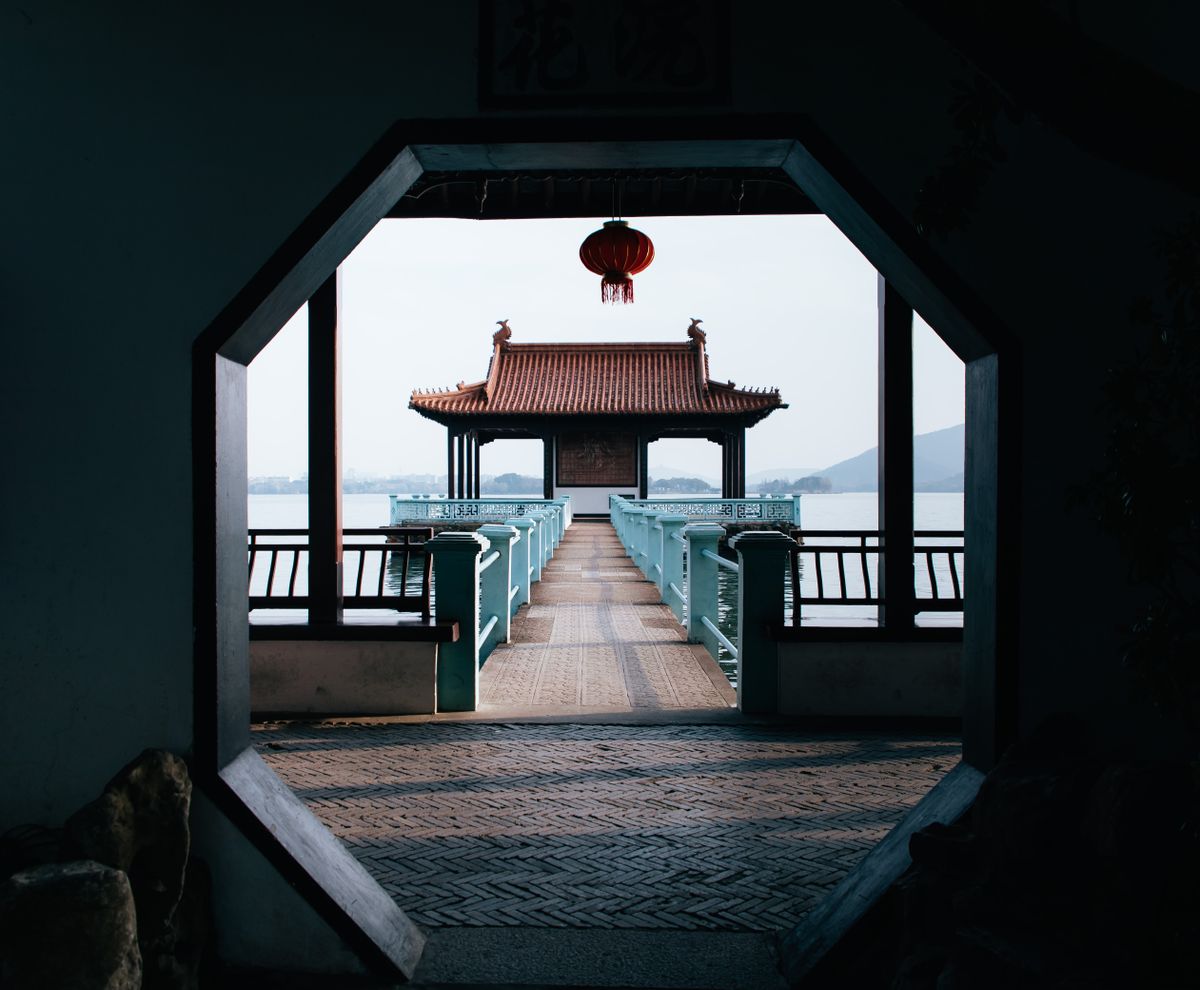
Lakeside pavilion and pier on Taihu Lake near Wuxi
Common mistakes on this route
- Assuming Pudong works like Hongqiao. It doesn't have a railway station attached; budget the transfer time described above.
- Booking the slowest D-train assuming it's automatically cheaper. Compare actual fares first; the gap is sometimes just a few yuan.
- Skipping Wuxi station names. Wuxi has more than one rail station (Wuxi Station and Wuxi East). Most Shanghai-Wuxi high-speed trains use Wuxi Station, close to the city center and closer to Lingshan, so double-check your ticket lists Wuxi Station and not Wuxi East before you board.
- Not verifying passport details match your ticket. China Railway matches the ID number on your ticket against your passport at the gate; a mismatched middle name or number will hold you up at security.
- Treating Lingshan as a quick stop. Between the statue, the palace, and the walk around the lakeside gardens, rushing it in under two hours means missing the Brahma Palace interior, which is the part most first-time visitors say they wish they'd budgeted more time for.
Who this day trip works for
This route makes the most sense if you're based in Shanghai for a few days and want a genuine change of scenery without an overnight bag. The train ride itself is short enough that you can leave after breakfast and be at the Buddha by late morning, then head back in time for dinner in Shanghai. It also works well if you're flying out of Pudong and want to see one more sight on the way, provided you build in the airport transfer time.
It makes less sense if you're already tight on time in Shanghai and only have one spare day. Between transfers, the scenic area's size, and the return trip, this is closer to a 7-8 hour outing door to door than a quick half-day add-on. If you're stacking multiple short rail trips from Shanghai, Suzhou is a similar 25-minute hop in the other direction and pairs well with a Shanghai to Suzhou train day trip if you want to compare both before deciding which fits your schedule.
FAQ
Is there a direct train from Shanghai to Wuxi, or do I need to transfer? Trains from Shanghai Hongqiao and Shanghai Station run direct to Wuxi with no transfer needed. The only transfer scenario is starting from Pudong Airport, which requires reaching a rail station first before boarding a Wuxi-bound train.
Which Shanghai station should I leave from, Hongqiao or Shanghai Station? Hongqiao is usually more convenient since it's connected to Hongqiao Airport and has the most frequent Wuxi departures. Shanghai Station (Shanghai Zhan) also runs trains on this route and can be a better pick if you're already staying near it.
Can I buy a Shanghai to Wuxi train ticket on the day of travel? Yes, in most cases. With 250-plus daily departures, same-day tickets are usually available except during major holiday travel windows, when booking a day or two ahead is safer.
Is the Lingshan Grand Buddha worth the trip if I only have one day in Wuxi? Yes, if you commit to the full loop rather than treating it as a quick photo stop. Between the statue, the Brahma Palace, and the lakeside setting, most visitors spend half a day there once travel time is included.
Do I need to print my train ticket, or is a phone screenshot enough? Neither is strictly required if you booked with your passport number: stations increasingly use ID-based automated gates that scan your passport directly. Carrying the physical passport you booked with matters more than having a printed ticket.