Nanjing to Suzhou Train: Time, Fares & Bullet Train Schedule (2026)
Nanjing and Suzhou sit on the same stretch of railway, the Shanghai-Nanjing intercity high-speed line, so this is effectively the middle segment of one continuous corridor rather than a route of its own. The distance is about 217 km. On the fastest nonstop G-trains, the bullet train time is 45 to 57 minutes; add a stop or two at Zhenjiang, Danyang or Wuxi and the ride stretches to 1 hour to 1 hour 20 minutes, which is the range most direct daytime departures run. Slower D-series trains can take 1 hour 30 minutes to 2 hours or more. With well over 150 high-speed departures a day, you rarely wait long for the next one.
For step-by-step guidance on registering, choosing between 12306 and Trip.com, and boarding with only your passport, see our complete guide to booking China's high-speed trains.
How long does the Nanjing to Suzhou bullet train take?
Journey time on this line depends almost entirely on how many stops a train makes, not on delays or seat class. The quickest G-trains run nonstop and cover the 217 km in under an hour, close to the physical limit for track built for 300-350 km/h operation. Trains that call at one or two of the smaller stations along the way, commonly Zhenjiang, Danyang North or Wuxi, add 15 to 30 minutes each. Booking platforms list the exact duration for every departure, so check the number next to the train code rather than assuming every G-train is equally fast.
This is one small piece of a much longer line. The full Shanghai-Nanjing corridor runs 301 km end to end, and Nanjing to Suzhou covers most of that distance without touching either terminus city. If you are stitching together a longer loop along the same line, the Shanghai to Nanjing train and the Shanghai to Suzhou train guides cover the two flanking legs; this ride is the connector in between, and it uses identical rolling stock, ticketing and station procedures.
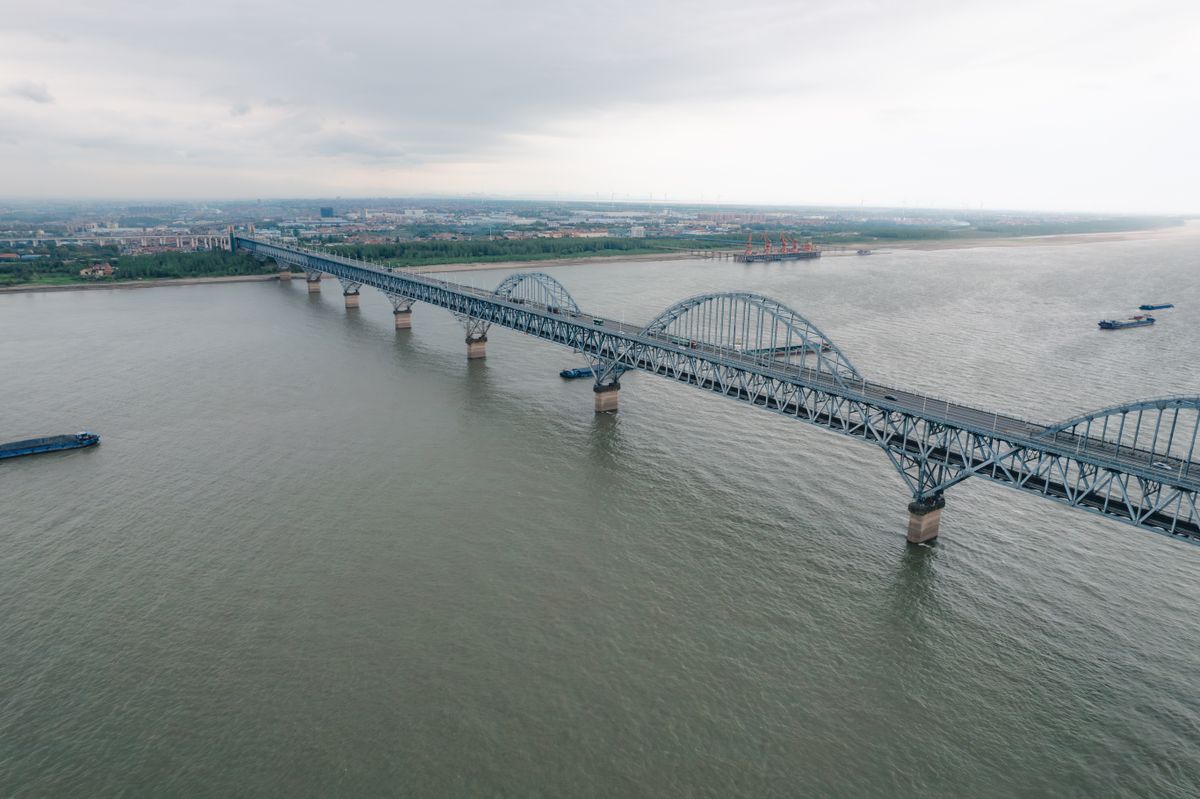
Aerial view of the Nanjing Yangtze River Bridge crossing the river
Nanjing to Suzhou train schedule and fares (2026)
Fares on Chinese high-speed rail are set by distance and seat class, not by how fast a specific train runs, so a nonstop G-train and one that stops twice cost the same. Here is what to expect on this route:
| Train type | Journey time | Departures per day | Second class | First class | Business class |
|---|---|---|---|---|---|
| G-train (up to 300-350 km/h) | 45 min to 1h20 | 150+ | around CNY 105 | around CNY 160-170 | around CNY 330-370 |
| D-train (slower EMU) | 1h30 to 2h+ | a handful | around CNY 65-70 | around CNY 110-115 | not offered |
Second class is the practical default for a ride this short: a standard reclining seat in a 3-2 layout, more than comfortable for an hour on the train. First class buys a wider 2-2 seat and extra legroom, worth it mainly if you want guaranteed space for a laptop or luggage during a busy commuter departure. Business class exists only on select G-trains and costs three to four times the second-class fare for a sub-hour ride, a better value on longer journeys than on this one.
Which station in Nanjing, which station in Suzhou
Nanjing has two stations that handle this line. Nanjing South Railway Station is the main high-speed hub: bigger, more modern, and the origin point for most departures, though it sits about 7 km south of the historic center. Nanjing Railway Station, the older and more central station, also serves some Huning-line trains and puts you closer to Xuanwu Lake, the Ming city wall and the old town, at the cost of slightly fewer departure choices. Pick based on where you are staying; our where to stay in Nanjing guide breaks down the neighborhoods near each station.
On the Suzhou side, the choice is simpler: use Suzhou Railway Station, not Suzhou North. Suzhou Railway Station sits on the Shanghai-Nanjing intercity line right at the northern edge of the Old Town, a short taxi or bike ride from the classical gardens. Suzhou North serves a different trunk line, the Beijing-Shanghai corridor, and adds 20 to 30 minutes of transfer to reach downtown, with no upside for this itinerary. If you are deciding where to base yourself once you land, see our where to stay in Suzhou guide.
Both stations run the same security routine as any Chinese high-speed station: passport scan, a bag scan, and boarding by assigned seat, so there is no paper ticket to lose. Arriving 20 to 30 minutes ahead of departure is enough at either station; gates typically close 5 minutes before the train leaves.
Booking your ticket
Book trains on Trip.com
English interface, foreign Visa/Mastercard, 24/7 support, small per-ticket fee
Some links are affiliate links; we may earn a commission at no extra cost to you.
Trip.com books the same seats sold on the Chinese platforms, in English, with cards issued outside China, and a small service fee added on top of the fare. It is the fastest way to lock in a departure time if you would rather not deal with a Chinese-language checkout or a verification step.
The free official alternative is 12306, China Railway's own booking site and app. It charges no service fee and sells at face value, but foreign travelers need to complete a one-time passport identity verification before their first purchase, and checkout leans on Alipay or WeChat Pay. For a short, well-served route like this one, either option gets you onto the same train; the real difference is fees versus setup time.
Whichever you use, tickets on this corridor rarely sell out outside major holidays such as Spring Festival or the October Golden Week, since departures run every 10 to 20 minutes at peak times. Booking a day or two ahead is usually enough, and same-day tickets are commonly available too, even for the earliest or most convenient departures.
What to do in Suzhou after you arrive: the gardens worth the trip
The reason to ride this leg of the line at all is what is waiting at the other end. Suzhou's classical gardens are the payoff, and Suzhou Railway Station puts you within easy reach of the best of them.
- Humble Administrator's Garden (Zhuozheng Yuan): the largest and most celebrated of Suzhou's gardens, built around a series of ponds, pavilions and covered walkways. Entry runs about CNY 70-80 depending on season. It caps daily visitors and books out in spring and around holidays, so reserve a time slot through the Suzhou Gardens WeChat mini-program before you travel. Budget 1.5 to 2 hours.
- Lingering Garden (Liu Yuan): smaller and less crowded, prized for its architecture and the way covered corridors frame each view of rock and water. Entry runs about CNY 45-55 depending on season. This is the better pick if the Humble Administrator's Garden is sold out or you want a quieter visit.
- Lion Grove Garden: known for a rockery maze of limestone that visitors can walk through, a short walk from the Humble Administrator's Garden and easy to combine with it on the same morning.
- Pingjiang Road: not a garden but a canal-lined old street a few minutes from the Humble Administrator's Garden, worth the walk between sights for the waterside houses and small bridges.
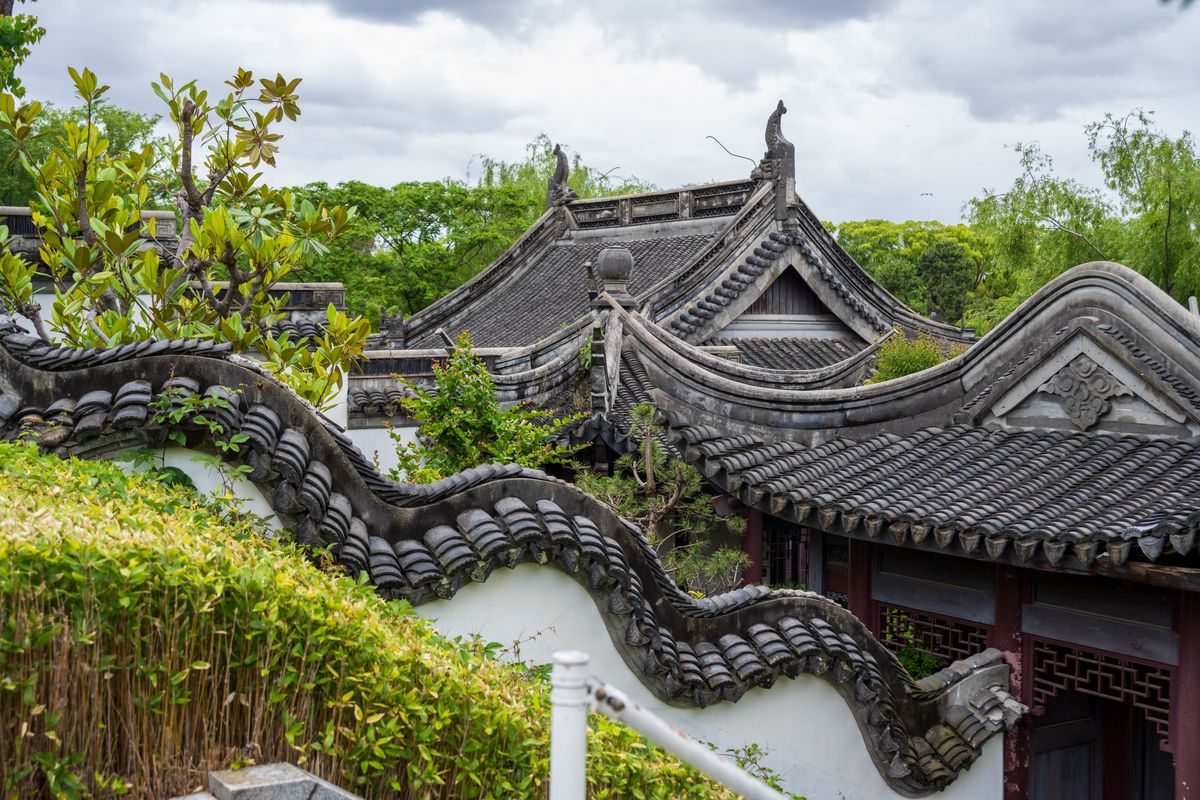
Classical Suzhou garden with an undulating white wall and dark tile roofline
Two or three gardens is a realistic day; trying to fit all four great gardens into one afternoon leaves you rushing between gates rather than looking at anything. If you want a fuller plan for the city, our Suzhou 2-day itinerary lays out which gardens pair well on the same day and where to base yourself in between.
Before you book, a short recap:
- Ride time depends on stops, not delays: check the listed duration for each train rather than assuming every G-train matches the fastest one.
- Second class is the sensible default for a ride under 90 minutes; save business class for longer trips.
- Nanjing South has the most departures; Nanjing Railway Station is closer to the old town if that matters to your schedule.
- Get off at Suzhou Railway Station, not Suzhou North, for anything garden-related.
- Reserve the Humble Administrator's Garden time slot ahead of arrival, especially in spring or around a public holiday.
FAQ
How long is the Nanjing to Suzhou train ride? The fastest nonstop G-trains take 45 to 57 minutes for the 217 km route. Trains with one or two intermediate stops typically take 1 hour to 1 hour 20 minutes, and slower D-series trains can run 1 hour 30 minutes or longer.
Is a G-train or a D-train better for this route? G-trains run more often and cost only a little more than D-trains for a noticeably shorter ride. Unless a specific D-train schedule fits your plans better, pick a G-train.
Which Nanjing station should I leave from? Nanjing South Railway Station has the most departures and the widest range of times. Nanjing Railway Station is a reasonable alternative if you are staying near the old town and want to save a taxi ride to the southern suburbs.
Do I need to book Nanjing to Suzhou tickets in advance? Not usually. With 150 or more high-speed departures a day, same-day tickets are commonly available outside major holidays. Booking a day ahead removes any risk around Spring Festival or Golden Week.
Can I visit Suzhou's gardens on a day trip from Nanjing? Yes. An early train gets you into Suzhou by mid-morning, leaving a full day for two or three gardens before an evening train back. Reserve the Humble Administrator's Garden time slot in advance if you want to include it, since it is the one that sells out.