China's 240-Hour Visa-Free Transit: What Changed From 144 Hours (2026)
Quick answer: China's visa-free transit window grew from 144 hours (6 days) to 240 hours (10 days) starting December 17, 2024, and now covers 24 provincial-level regions and 65 entry-exit ports (up from 60 after a November 2025 expansion). Citizens of 55 eligible countries can use it with a confirmed onward ticket to a third country or region, and unlike the older 144-hour rule's single-region lock, travelers can now move freely between any of the 24 covered provinces during their stay. Bring a passport valid at least three months, your booked exit ticket, and enter/exit only through the listed ports.
Land in Shanghai, take a bullet train to Chengdu three days later, then fly out from Kunming a week after that. Under the old rules, that itinerary would have broken the transit-visa exemption the moment you crossed a regional line. Since December 2024, it's legal, and it's one of the more useful changes to China's entry rules in years.
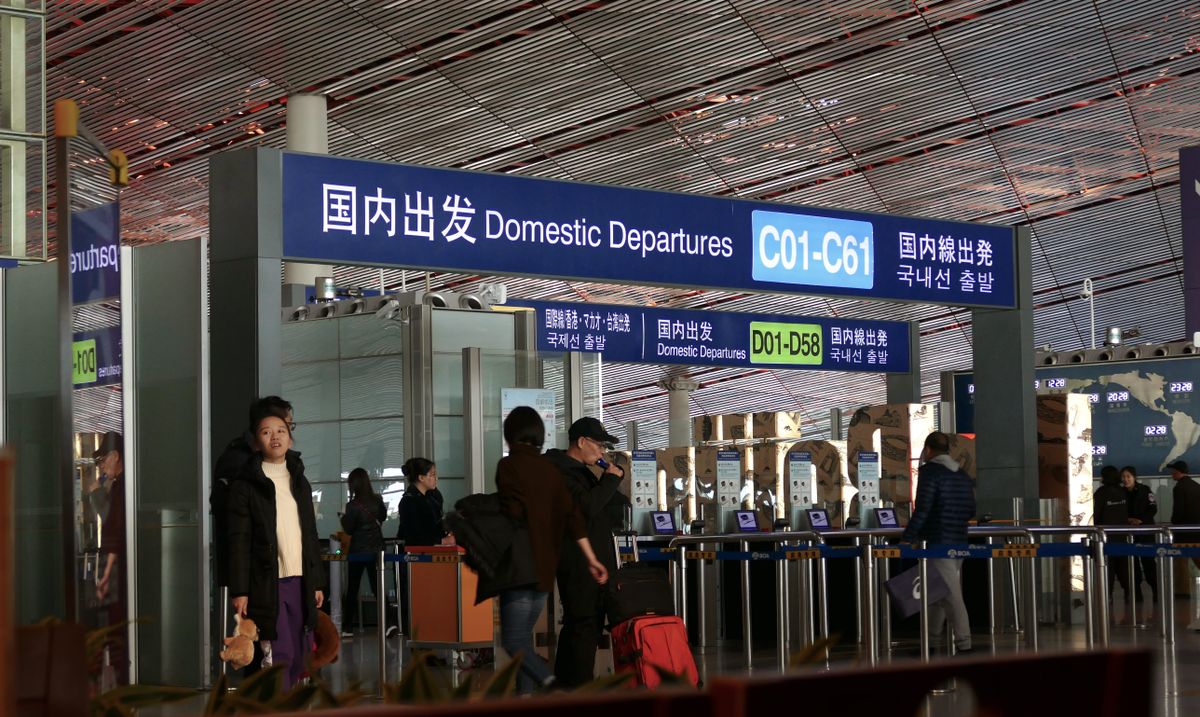
Beijing Capital Airport domestic departures hall with signage in Chinese, English, Japanese and Korean
What changed from 144 hours to 240 hours
The 144-hour (6-day) visa-free transit exemption had existed in various forms since 2013, letting travelers from eligible countries skip a visa if they were passing through China on the way to a third country. The catch: the stay window was short, and in most versions of the rule you had to stay inside one linked region, such as the Beijing-Tianjin-Hebei cluster or the Yangtze River Delta (Shanghai, Jiangsu, Zhejiang, Anhui).
On December 17, 2024, the National Immigration Administration extended the maximum stay to 240 hours (10 days) and applied it across 24 provincial-level regions at once, rather than region by region. The port count kept growing after that: a November 5, 2025 update added five more crossings in Guangdong, including Guangzhou, Zhuhai's Hengqin and Zhongshan checkpoints, the Hong Kong-Zhuhai-Macao Bridge, and the West Kowloon high-speed rail station, taking the total from 60 to 65 ports.
The bigger practical shift isn't just the extra four days. It's that the 240-hour version dropped the single-region lock. You can now land in one covered province and travel through several others before exiting, as long as your entry and exit points are both on the approved port list.
Which provinces and ports qualify
As of 2026, the 240-hour scheme covers these 24 provincial-level regions: Beijing, Tianjin, Hebei, Shanghai, Jiangsu, Zhejiang, Anhui, Fujian, Jiangxi, Shandong, Henan, Hubei, Hunan, Guangdong, Guangxi, Hainan, Chongqing, Sichuan, Guizhou, Yunnan, Shaanxi, Shanxi, Liaoning, and Heilongjiang.
Notably absent: Tibet, Xinjiang, Gansu, Qinghai, Ningxia, Inner Mongolia, and Jilin. If your trip includes any of those, you'll need an actual visa regardless of how short the stay is.
| Old 144-hour rule (pre-Dec 2024 versions) | Current 240-hour rule (2026) | |
|---|---|---|
| Maximum stay | 144 hours (6 days) | 240 hours (10 days) |
| Regions covered | Fewer, added city/cluster by city/cluster | 24 provincial-level regions at once |
| Ports of entry/exit | Varied by cluster | 65 designated ports nationwide |
| Travel between regions | Generally locked to one linked cluster | Free movement across all 24 regions |
| Onward ticket required | Yes | Yes |
Not every airport or land port in those 24 regions is on the list. Before you book a connecting flight or train, check your specific entry and exit points against the current port list published by the immigration bureau or your airline's visa-free transit desk, since new crossings get added periodically and a port that's fine for arrival isn't automatically approved for departure.
Who qualifies and what you need
The eligible-nationality list mirrors China's broader visa-free transit program: 55 countries, including most of Europe, the United States, Canada, Australia, New Zealand, Japan, South Korea, Singapore, the UAE, and several South American countries such as Brazil, Argentina, Chile, and Mexico. Check the current list against your passport before booking, since it has been revised more than once.
To use the 240-hour exemption you need:
- An ordinary passport valid for at least three months beyond your planned exit date.
- A confirmed onward ticket (flight, train, or cruise) to a third country or region, dated within the 240-hour window from your arrival.
- Entry and exit through ports on the approved list.
- A declared itinerary that stays within the 24 covered regions.

High-speed train arriving at Shanghai Railway Station with the city skyline behind it
Permitted activities are tourism, business meetings, and visiting family or friends. Work, study, or journalism assignments still require the matching visa category, even if the trip is short enough to fit inside 240 hours.
Common mistakes
- Assuming any port works for exit. Entering through an approved airport doesn't automatically mean every land or rail crossing near your route is on the list. Some travelers get stopped trying to exit through a smaller port that simply isn't part of the 65.
- Booking an open-dated or one-way onward ticket. Immigration checks for a dated, confirmed ticket to a genuine third country or region. A flexible or unbooked return doesn't satisfy the requirement.
- Confusing this with the 24-hour airport transit rule. A separate, more limited allowance lets some nationalities transit certain airports for up to 24 hours without going through immigration at all, mainly for a same-airport connection. That's not this policy, and the rules and ports differ.
- Assuming the old region-lock still applies. Guides written before late 2024 often describe a Yangtze-Delta-only or Beijing-Tianjin-Hebei-only restriction. That cluster lock no longer governs the 240-hour version; you can now cross between any of the 24 regions.
- Skipping the passport validity check. Three months of remaining validity is a hard requirement, not a suggestion, and it trips up more travelers than any other item on this list.
Who this is for
This exemption is built for people already flying through China on the way somewhere else: a stopover trader connecting Seoul to São Paulo through Guangzhou, a backpacker breaking up a long-haul flight with a week in Yunnan, or a business traveler adding a Shanghai meeting to a Tokyo-London routing. It works well if your full trip, start to finish, fits inside 10 days and ends in a country other than the one you started from.
It's the wrong tool if you want to stay longer than 10 days, plan to work or study while in China, or intend to fly in and out of the same country (a genuine round trip home doesn't count as heading to a "third" country or region). In those cases, apply for an ordinary tourist (L) or business (M) visa instead.
Before you book
- Confirm your passport's nationality is currently on the 55-country list.
- Book your onward ticket first, then build your China itinerary around the confirmed dates.
- Cross-check both your entry port and exit port against the current 65-port list, not just one of them.
- Register your entry information online in advance if your port supports it; the immigration administration opened online pre-arrival submission in November 2025 to speed up processing.
- Keep a printed copy of your itinerary and onward ticket in case a checkpoint officer asks for paper backup.
FAQ
Do I need a visa to transit China for up to 10 days? Not if you hold a passport from one of the 55 eligible countries, have a confirmed onward ticket to a third country or region dated within 240 hours, and enter/exit through approved ports. Otherwise, yes, you need a standard visa.
Can I enter through Shanghai and exit through Beijing under the 240-hour rule? Yes, as long as both cities' ports are on the current 65-port list and both are within the 24 covered regions. The old single-cluster restriction no longer applies to the 240-hour version.
Is the 144-hour visa-free transit still available anywhere in China? The 240-hour allowance has effectively superseded the 144-hour version across the 24 regions covered here. Some ports outside this list may still run older or different transit arrangements, so always check the port-specific rule rather than assuming a blanket policy.
What counts as a "third country or region" for the onward ticket requirement? Any destination other than the country you departed from before arriving in China. A round trip back to your home country doesn't qualify; you need to be genuinely continuing on to somewhere else.
What happens if my connecting flight gets cancelled during my 240 hours? Contact your airline and the nearest exit-entry administration office immediately. Overstaying without approval risks fines and can affect future China entries, so don't wait until the last day to sort out a schedule change.
Not sure if you even need a visa?
Check your China visa-free eligibility →
Sources
- Visa-Free Transit Policies · National Immigration Administration of China (NIA)
- China widens visa-free access in latest opening-up move · The State Council of the People's Republic of China