Hungry Ghost Festival China 2026: Date, Customs & Etiquette
The Hungry Ghost Festival in China falls on Thursday, August 27, 2026, the fifteenth day of the seventh lunar month. It is called Zhongyuan Jie in Chinese and centers on remembrance, offerings and care for ancestors and unclaimed spirits. It is not a national public holiday.
Some families and temples observe rites across the whole seventh lunar month, which begins on August 13 in 2026. Customs differ by region, religion and family. A visitor may see incense, food offerings, paper offerings or temple ceremonies, but should not expect a nationwide street festival.
For the wider calendar, see our guide to Chinese festivals and holidays.
When is the Hungry Ghost Festival in 2026?
The Hong Kong Observatory's official Gregorian-lunar conversion table places the fifteenth day of the seventh lunar month on August 27, 2026. The seventh lunar month runs from August 13 to September 10 that year.
| Date in 2026 | Lunar date | Meaning |
|---|---|---|
| August 13 | Seventh month, day 1 | Start of the seventh lunar month |
| August 27 | Seventh month, day 15 | Zhongyuan Jie, the main festival date |
| September 10 | Seventh month, day 29 | Final day of that lunar month |
Some southern communities observe important rites on the fourteenth day, and event times may follow a temple's own calendar. Use August 27 as the main date, then check the host's notice.
What does Zhongyuan Jie mean?
Zhongyuan Jie developed through overlapping folk ancestor practices, Daoist rites and Buddhist Yulanpen traditions. These are related layers, not one uniform ceremony. Families may honor their own ancestors, while community rites can also address spirits without descendants to make offerings for them.
Calling it “Chinese Halloween” hides the central idea. Halloween often emphasizes costumes and play. Zhongyuan observances are usually tied to remembrance, duty, ritual giving and ideas about relations between living and dead.
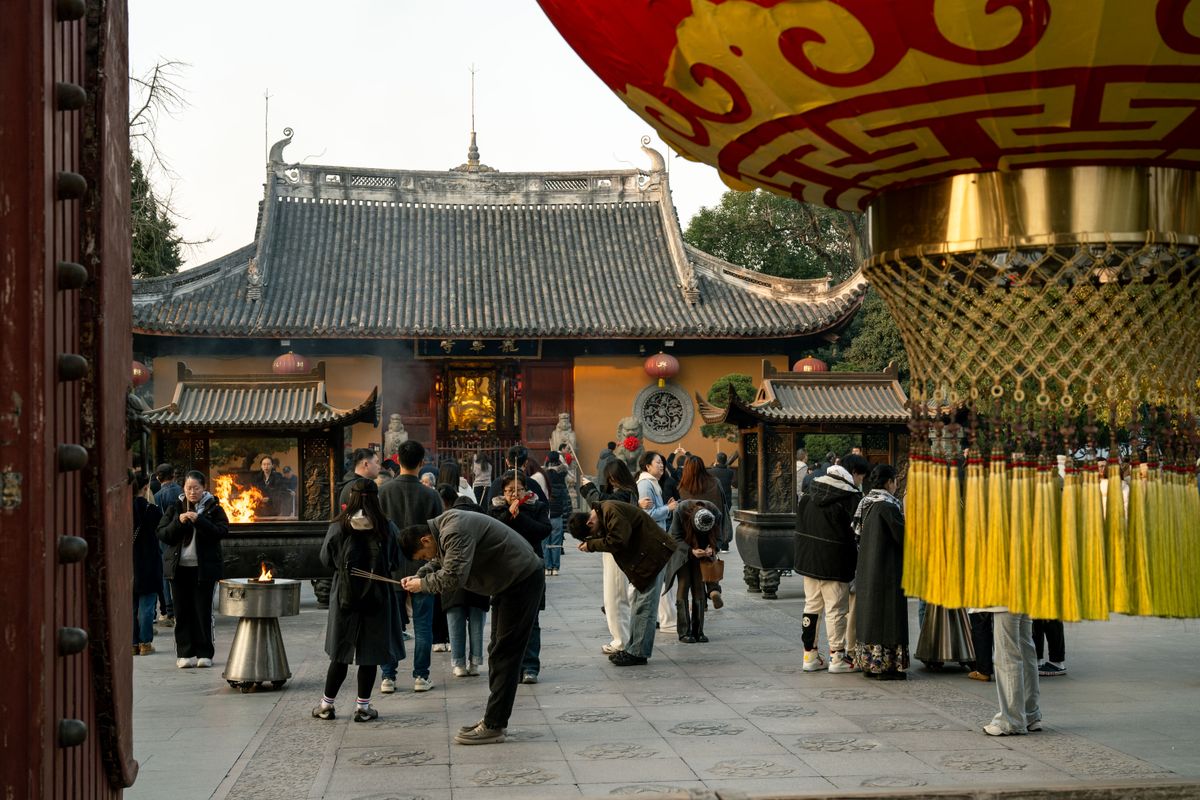
Visitors making incense offerings in a Shanghai temple courtyard
The name Hungry Ghost Festival is common in English, but it can make every rite sound fearful. Many participants understand the period through filial respect and generosity. Watch how the host community describes its own event before choosing words or taking photos.
What customs might a traveler see?
| Custom | What it represents | Respectful visitor response |
|---|---|---|
| Food offerings | Hospitality for ancestors or spirits | Do not touch, move or taste them |
| Incense | Prayer, remembrance or ritual communication | Stand clear and follow temple fire rules |
| Joss paper or paper objects | Symbolic goods offered through burning | Do not copy the rite without guidance |
| Lamps or lanterns | Light, guidance or merit in some traditions | Watch from outside the working area |
| Scripture chanting or opera | Religious merit or community offering | Keep silent and follow seating signs |
| Roadside or doorway offerings | A household or local rite | Walk around the setup, not through it |
Paper burning is increasingly controlled because of fire risk, smoke and local environmental rules. Use only a designated burner when invited. Never start a fire on a pavement, riverbank or temple corner because you saw someone else do it.
How should visitors behave at a ceremony?
Arrive as an observer, not as the center of the scene. Clothing does not need to be formal unless the host says so, but covered shoulders and quiet colors are sensible in a temple. Keep pathways, altars and working areas open.
Follow these steps:
- Read entrance signs and look for a photography rule.
- Ask before photographing a person, altar or family offering.
- Turn off flash and shutter sounds where possible.
- Do not stand between a worshipper and the altar.
- Do not step over paper, incense, food or chalked ritual boundaries.
- Leave if staff begin a private part of the rite.
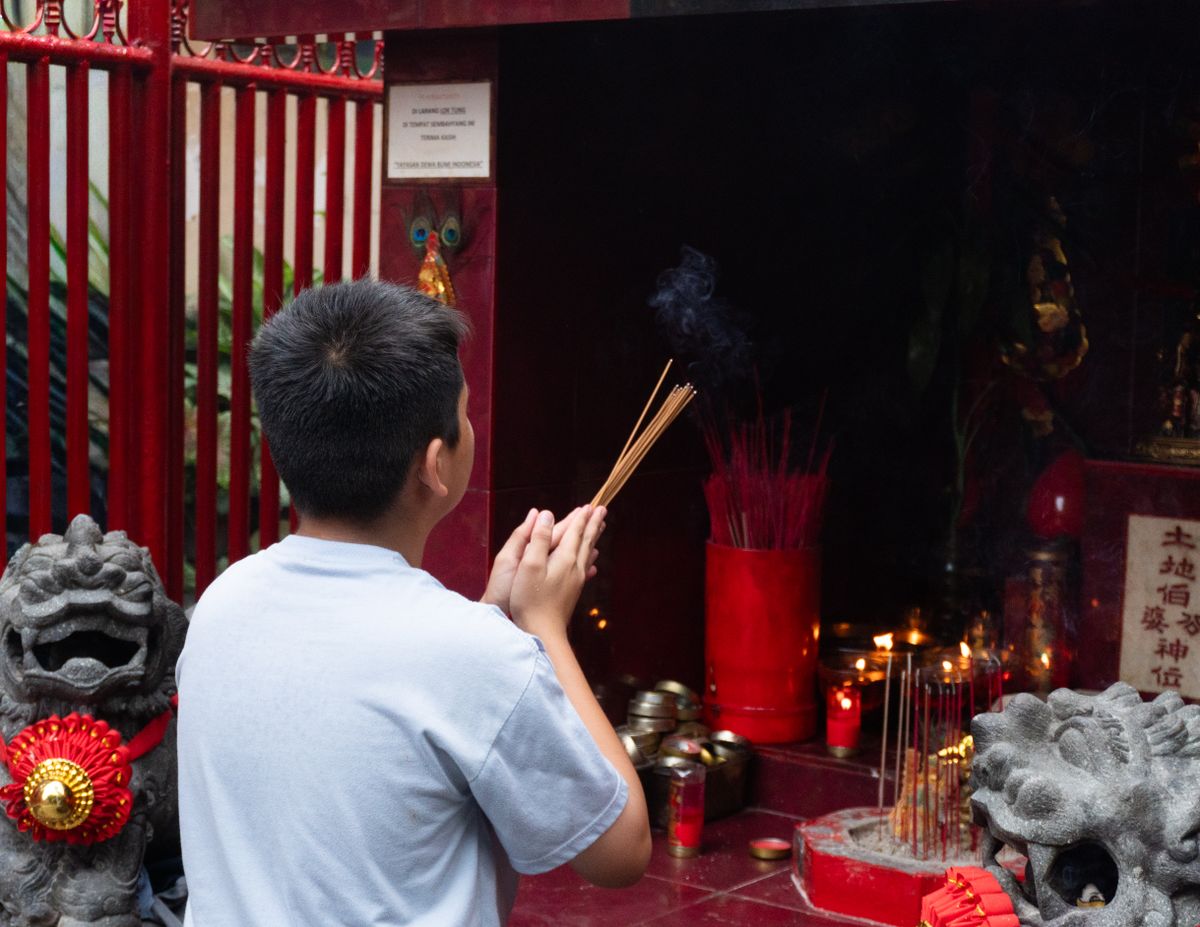
Young worshipper holding incense at a Chinese temple altar
If someone gives you incense, copy the host's position and number of bows only after they explain it. Temple practices vary. A video from another province is not a reliable instruction for the ceremony in front of you.
Where can travelers see observances in China?
Zhongyuan rites are often easier to encounter in Fujian, Guangdong, Hong Kong and other southern Chinese communities, where temple and neighborhood traditions remain visible. Parts of the lower Yangtze and many other regions also have family or temple observances. Visibility does not mean the event is staged for tourists.
Check municipal culture listings, temple notices and hotel concierge information a week before August 27. Ask whether the event is public, when visitors may enter and if photography is allowed. Do not travel to an unverified roadside address late at night expecting a show.
Public temple chanting or community opera may welcome observers. Family ancestor rites in a home, shop doorway or grave area are private unless you receive a direct invitation.
Common misconceptions to leave at home
- “Every Chinese person follows the taboos”: Belief and practice vary widely.
- “The festival is a public holiday”: August 27, 2026 is a normal workday nationally.
- “All seventh-month events happen at midnight”: Many rites occur in daylight or early evening.
- “Offerings are litter”: They may be part of an active rite; do not move them yourself.
- “A temple is a photo set”: Worshippers' privacy comes before a travel image.
What about Ghost Month taboos?
You may hear advice not to swim at night, whistle after dark, pick up money on the road, hang wet clothes outside or schedule a wedding during the seventh month. These are folk beliefs, not laws and not universal rules. A traveler does not need to organize an itinerary around every taboo.
The useful response is social awareness. If a host avoids an activity or date for family reasons, do not mock it or demand a debate. If your hotel, attraction or transport booking operates normally, the lunar month itself does not block travel.
A respectful evening plan for August 27
Choose one public venue whose notice confirms visitors. Arrive before dark, observe from the edge and leave enough time for ordinary transport home. Eat before or after the visit rather than treating ritual food as a market snack. Carry no open flame and follow local smoke restrictions.
Pairing the evening with a daytime museum visit gives the history more context. If no public event is confirmed, read about the custom and continue the trip. Inventing a ceremony for a photo is worse than seeing none.
The festival comes shortly after Qixi in China in 2026 and before the Mid-Autumn Festival, but the mood and purpose of each are different.
Frequently asked questions
What date is the Hungry Ghost Festival in 2026?
The main date is Thursday, August 27, 2026. It is the fifteenth day of the seventh lunar month according to the Hong Kong Observatory's 2026 conversion table.
Is the Hungry Ghost Festival a public holiday in China?
No. It is a traditional observance, not a nationwide statutory holiday. Shops, trains and offices generally follow normal schedules unless a local event changes access.
Can tourists watch Zhongyuan Jie ceremonies?
Some temple and community events are public, while family rites are private. Confirm the venue's rules, stay outside working areas and ask before taking close photographs.
Is Hungry Ghost Festival the same as Halloween?
No. Both involve ideas about spirits, but Zhongyuan practices focus on ancestors, offerings, merit and care for the dead. Costumes and trick-or-treating are not defining customs.
Should travelers follow Ghost Month taboos?
They are beliefs rather than legal restrictions. You can travel normally, while respecting a host or community that chooses to follow them.
Sources
- Gregorian-Lunar Calendar Conversion Table 2026 · Hong Kong Observatory
- Gregorian-Lunar Calendar Conversion · Hong Kong Observatory