How to Play Chinese Mahjong: Beginner Rules and Table Etiquette (2026)
Mahjong in China is not one single ruleset. A family in Chengdu, a club in Shanghai and an international tournament may score the same tiles differently. A beginner should first learn the shared turn structure, then ask one question before play: "Which rules and minimum score are we using?"
The Palace Museum dates one of its Qing-dynasty court sets to the late imperial period and explains that mahjong grew from earlier Chinese card and tile games. By the late Qing, it had become a popular leisure game. Today it remains a social activity as much as a contest.
What do you need to play Chinese mahjong?
A common complete set has 144 tiles:
| Tile family | Contents | Number |
|---|---|---|
| Characters | 1 to 9, four of each | 36 |
| Bamboo | 1 to 9, four of each | 36 |
| Dots | 1 to 9, four of each | 36 |
| Winds | East, South, West, North | 16 |
| Dragons | Red, Green, White | 12 |
| Flowers and seasons | Eight bonus tiles | 8 |
Some regional games remove the flowers or use a different total. Four people is standard. Each player normally holds 13 tiles, draws one, and discards one. The dealer starts with an extra tile and discards first.
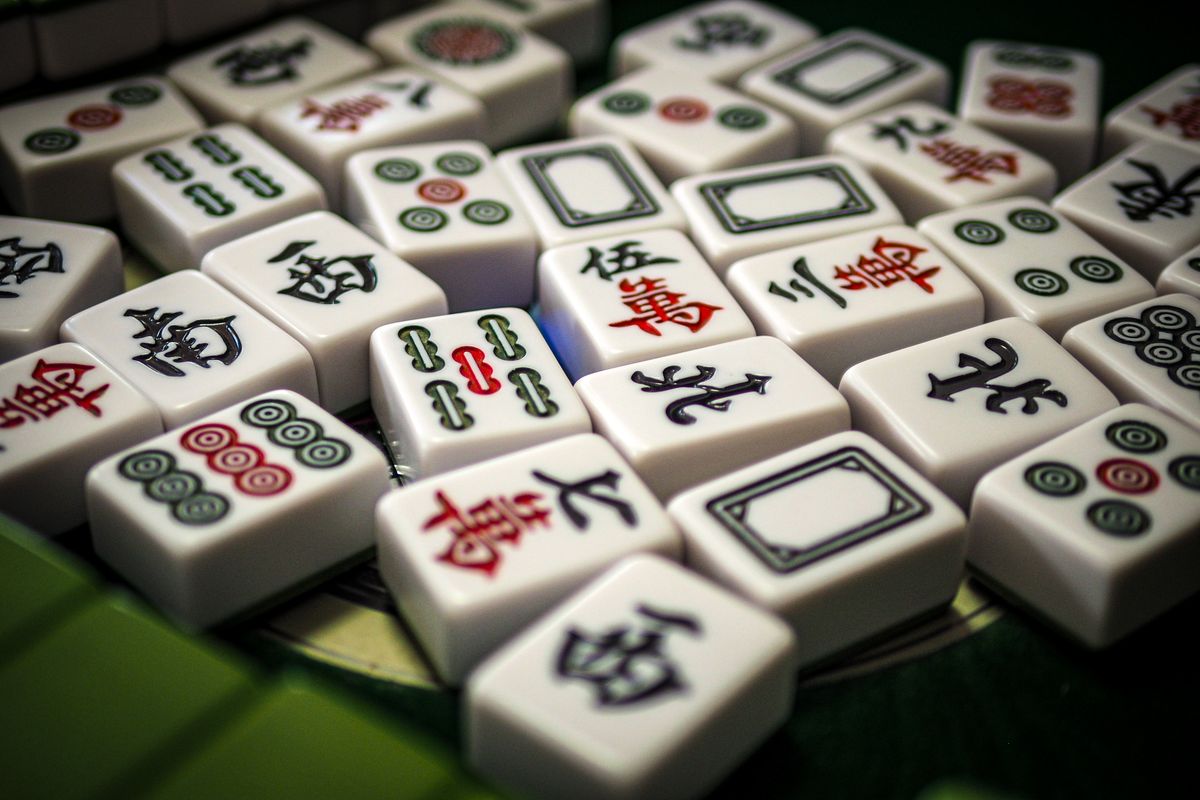
Close view of Chinese mahjong tiles
What makes a winning mahjong hand?
The basic shape is four sets and one pair, using 14 tiles:
- Chow: three consecutive numbers in one suit, such as 3-4-5 bamboo.
- Pung: three identical tiles.
- Kong: four identical tiles, declared with a replacement draw.
- Pair: two identical tiles.
A special hand may ignore that shape, but beginners should start with four sets and a pair. A structurally complete hand does not always qualify to win. Chinese Official or Mahjong Competition Rules use an eight-point minimum and many scoring patterns. Sichuan, Guangdong, Hong Kong and household systems use different conditions.
When joining a casual table, ask the host to name the variant and explain the minimum win. Do not bring rules from American mahjong or Japanese riichi and assume they apply.
How does one turn work?
- Draw the next tile from the wall.
- Check whether it completes your hand.
- If not, discard one tile face up.
- Another player may claim the discard under the table's rules.
- Play continues anticlockwise until someone wins or the wall reaches its stopping point.
A pung or kong can usually be claimed from another player's discard. A chow is normally claimed only from the player immediately before you in turn order. A winning discard can be claimed when the rules permit.
Keep your drawn tile separate for a moment. That habit helps you remember what changed and prevents accidental exposure of the hand.
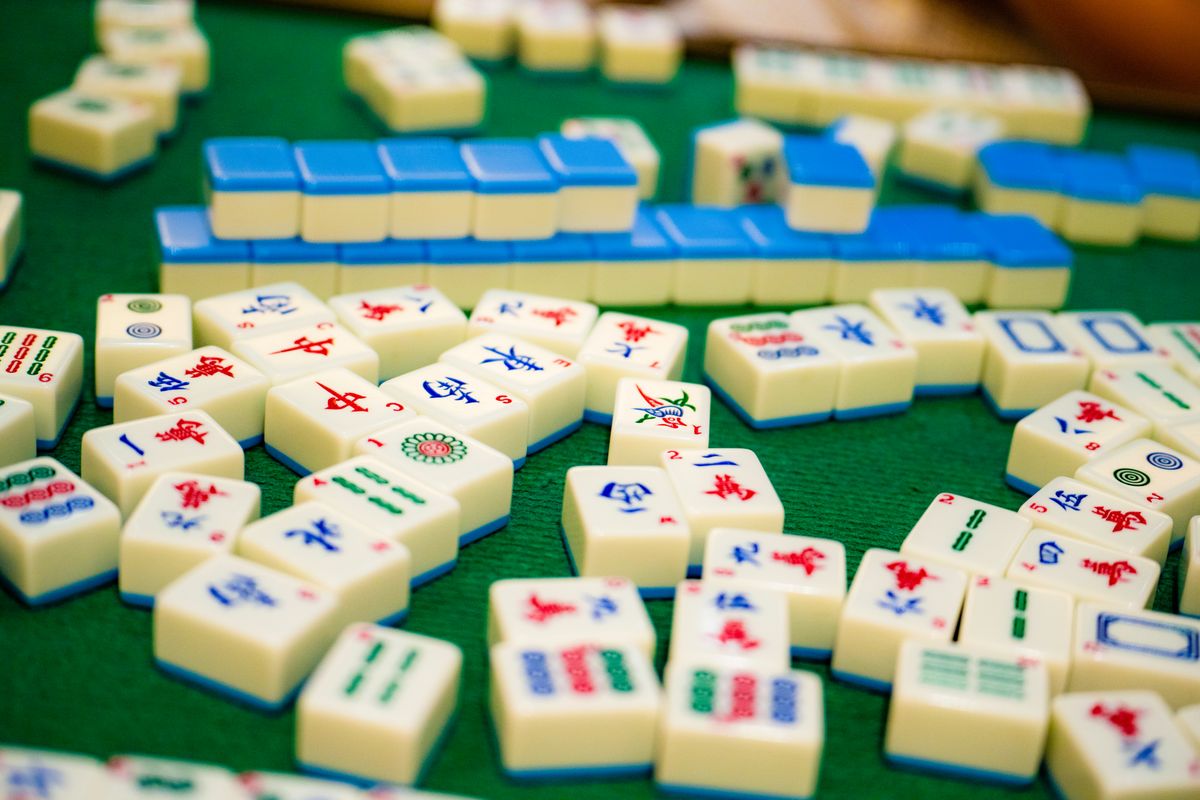
Mahjong wall and loose tiles on green felt
How do you set up the table?
Turn all tiles face down and mix them with both hands. Each player builds a wall two tiles high. The four walls form a square. Traditional play uses dice and dealer position to decide where the wall opens; an automatic table shuffles and raises the walls.
For a first teaching game, the host can deal without making beginners memorize the full dice procedure. What matters is that everyone agrees on dealer rotation, dead-wall use, flowers and scoring before the first hand.
Useful table words:
- mahjong tiles: a plain English term for the tiles; mahjong is the normal game name.
- chi: claim a chow.
- peng: claim a pung.
- gang: declare a kong.
- hu: declare a win.
- dong: East, often the dealer's seat wind.
Chinese mahjong variants you may encounter
| Variant | Beginner should know |
|---|---|
| Chinese Official / MCR | Standard tournament system, 144 tiles, many scoring elements and an eight-point minimum |
| Sichuan Bloody Rules | Often removes Characters or another suit after an exchange; play may continue after the first winner |
| Hong Kong style | Familiar four-sets-and-pair structure with its own fan minimum |
| Family or park rules | Local scoring, payments and flower rules may be simplified or highly specific |
The Mahjong International League recognizes MCR, riichi and Sichuan rules among its main competitive systems. That is useful proof that "Chinese mahjong" needs a variant label.
Table etiquette in China
Ask before photographing people or the table. Keep drinks away from the automatic table opening. Place discards where everyone can see them and say a claim promptly. Do not touch another player's tiles, change a discard after releasing it, or coach someone whose hand is still live.
Money play is not automatic. Some families use points, tokens or no stakes. Ask the host before the first hand and decline politely if you are uncomfortable. Private gambling laws and venue rules matter; a visitor should not assume a casual invitation involves money.
Sound is part of the game. Tiles are mixed loudly and claims are spoken, but shouting at mistakes or slowing every turn to calculate with a phone will frustrate the table. For a teaching game, agree that one experienced player can explain open information after each hand.
A 20-minute beginner teaching plan
- First five minutes: learn the three suits, winds and dragons.
- Next five: build sample chows, pungs and a pair.
- Next five: play open-handed without scoring.
- Final five: add claims and one simple win condition.
After that, play one full hand with all tiles concealed. Add detailed scoring only when the turn order feels natural.
Pair the game with a quiet tea break rather than placing cups beside the tiles. Our Chinese tea culture guide explains common tea-service manners.
What to remember before your first game
Learn four sets plus one pair, keep 13 tiles between turns, and ask which regional rules are in use. A polite question about scoring saves more confusion than memorizing a long tournament chart.
Sources checked
- Palace Museum: Qing-dynasty mahjong set and game history
- Mahjong International League: recognized competition systems
Frequently asked questions
Is Chinese mahjong the same as American mahjong?
No. American mahjong commonly uses jokers, racks and a yearly hand card. Chinese variants use different hand and scoring systems.
How many tiles does each player start with?
Most players hold 13 tiles. The dealer begins with 14 and makes the first discard.
Can two or three people play?
House variants exist, but the standard game is designed for four. Learn with four if you want the turn and claim rules used at most Chinese tables.
Do you have to gamble when playing mahjong in China?
No. Many games use points or no money. Ask before play and do not assume stakes are required.
Sources
- Bone mahjong tiles from the Qing dynasty collection · Palace Museum
- Mahjong International League · Mahjong International League