China Travel Advisory 2026: What Official Warnings Mean
Quick answer: China is open to tourists in 2026, but official advice differs by passport country. Check your own government's live page, understand local-law and exit-ban warnings, then insure the trip and carry a simple emergency plan.
Searching for a “China travel advisory 2026” often produces conflicting labels. That does not mean one government has better information than another. Each country uses its own scale, wording, legal duties and insurance rules. As checked on July 27, 2026, the United States lists mainland China at Level 2, “Exercise increased caution,” while the United Kingdom publishes topic-based warnings without the same numbered scale. Treat the advisory written for your nationality as the controlling reference.

Passengers boarding an international flight in Beijing
Is China safe to visit in 2026?
For most leisure visitors, the practical risks are manageable with preparation. Serious street crime against tourists is not the main issue highlighted by official pages. The repeated concerns are strict enforcement of local laws, possible exit bans connected to legal or commercial disputes, limits on consular help for people China considers Chinese nationals, scams, typhoons on the southern and eastern coasts, and restrictions around protests or sensitive sites.
An advisory is not a prediction that something will happen to you. It is a decision tool. Read the reason attached to the level, not only the color or number. A beach trip to Sanya, a week in Beijing, a business dispute in Shanghai and an organized Tibet tour do not carry the same practical questions.
| Check | What to verify before departure | Why it matters |
|---|---|---|
| Entry permission | Visa, visa-free eligibility, passport and onward ticket | Airline and border staff make separate checks |
| Insurance | Medical care, evacuation, delays and advisory exclusions | Some policies restrict cover after warnings change |
| Local registration | Hotel registration or police registration for private stays | Hotels normally handle this at check-in |
| Communications | Working roaming or eSIM plus offline copies | Some foreign services are unavailable on local networks |
| Regional rules | Permits for Tibet and current weather alerts | Access and transport can change with little notice |
What the main official warnings cover
The U.S. advisory page cites arbitrary enforcement of local laws, including exit bans. The UK page asks travelers to follow local laws, avoid demonstrations, monitor typhoons from May to November and obtain the required permit and organized tour for the Tibet Autonomous Region. These warnings deserve attention, but they should not be rewritten as a claim that ordinary tourism is prohibited.
Keep political demonstrations, military areas, border installations and police activity out of your camera frame. Do not bring recreational drugs or assume a prescription that is legal at home is automatically legal in China. Business travelers should settle contract, debt and employment questions before arrival and get qualified legal advice when a dispute exists.
For current entry paperwork, use the 2026 China entry requirements guide and the online arrival card instructions. Rules for Hong Kong and Macao are separate from mainland rules.
A practical safety plan for first-time visitors
Save your embassy or consulate contact, insurer assistance number and hotel address in both English and Chinese. Give one person at home your itinerary. Keep a photo of your passport and visa page in encrypted cloud storage, but carry the original passport when transport, hotels or police checks require identification.
China's main emergency numbers are 110 for police, 119 for fire and 120 for medical emergencies. English service is not guaranteed. Ask hotel staff, station staff or a nearby shop worker to call if communication becomes difficult. Record the Chinese name of any medication and bring the prescription and original packaging.
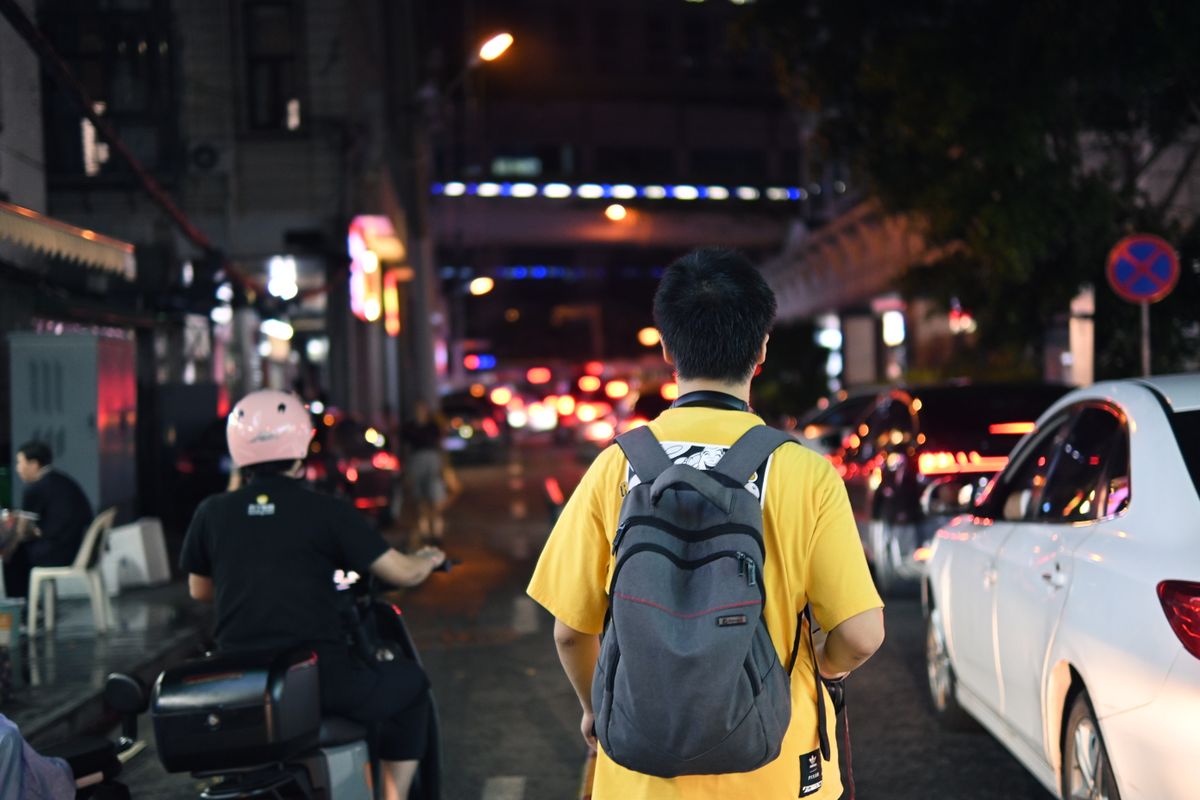
A traveler walking through a Chinese city at night
For digital preparation, install maps, translation and payment tools before flying. Read the essential China apps guide and test your card in Alipay or WeChat Pay before departure. Keep a physical bank card and some renminbi as backups. A dead phone should be an inconvenience, not the end of your travel plan.
Weather and transport risks that change by season
Typhoon season normally affects the southern and eastern coast from May to November. A forecast track can change, so follow the China Meteorological Administration, airline messages and local instructions. Do not travel to a waterfront for photographs during a warning. See the detailed China typhoon season guide for route changes and packing advice.
Winter creates a different set of problems: ice, cold exposure and disrupted road transfers in the northeast and at mountain sites. Summer heat can be severe in cities such as Chongqing, Wuhan and Nanjing. Build spare time around long-distance connections and avoid placing a separate, nonrefundable flight immediately after a train arrival.
Common mistakes
- Reading a social-media screenshot instead of the live government page and its update date.
- Assuming one country's Level 2 has the same definition as another country's Level 2.
- Buying insurance without checking exclusions tied to government advice or pre-existing conditions.
- Photographing a protest, police operation or restricted facility out of curiosity.
- Leaving every ticket, address and payment method inside one phone.
Who this is for
This guide is for tourists, families and independent travelers deciding how to interpret official notices before a normal leisure trip. It is also useful for visitors combining mainland China with Hong Kong or Macao, provided they check each jurisdiction separately.
It is not a substitute for legal advice, medical advice or a security assessment for journalism, activism, government work, research in sensitive fields or a live commercial dispute. Those travelers should speak to their employer, insurer, embassy and a qualified adviser before booking.
Your final 24-hour check
Open your own government's China page, confirm entry documents, save insurance details, download offline addresses and check weather along the route. If the advice changes after booking, call the insurer and travel provider before canceling anything. Keep screenshots for reference, but rely on the live page for the decision.
Frequently asked questions (FAQ)
Is there a travel advisory for China in 2026?
Yes. Many governments publish China travel advice, but their scales and wording differ. Use the page issued for your nationality and check its current date before departure.
Is China Level 2 right now?
The U.S. Department of State lists mainland China at Level 2 as checked on July 27, 2026. Other governments do not necessarily use the same system, so “Level 2” should not be applied worldwide.
Does a travel advisory cancel travel insurance?
Not automatically. Policies differ, and exclusions can depend on when you bought the policy, the stated reason for the warning and whether you followed official advice. Ask the insurer in writing.
What emergency numbers work in China?
Call 110 for police, 119 for fire and 120 for an ambulance. Save your hotel phone number as well because staff can help explain your location in Chinese.
Should I carry my passport in China?
Official advice says travelers may need to show identification, and passports are required for hotels and many train journeys. Carry it securely when needed and keep separate digital and paper copies.
Sources
- China travel advice · UK Foreign, Commonwealth & Development Office
- China entry requirements · UK Foreign, Commonwealth & Development Office